

Fong Lam, MD, pairs pediatric ICU care with translational research to solve clinical puzzles.
By Meredith Sell
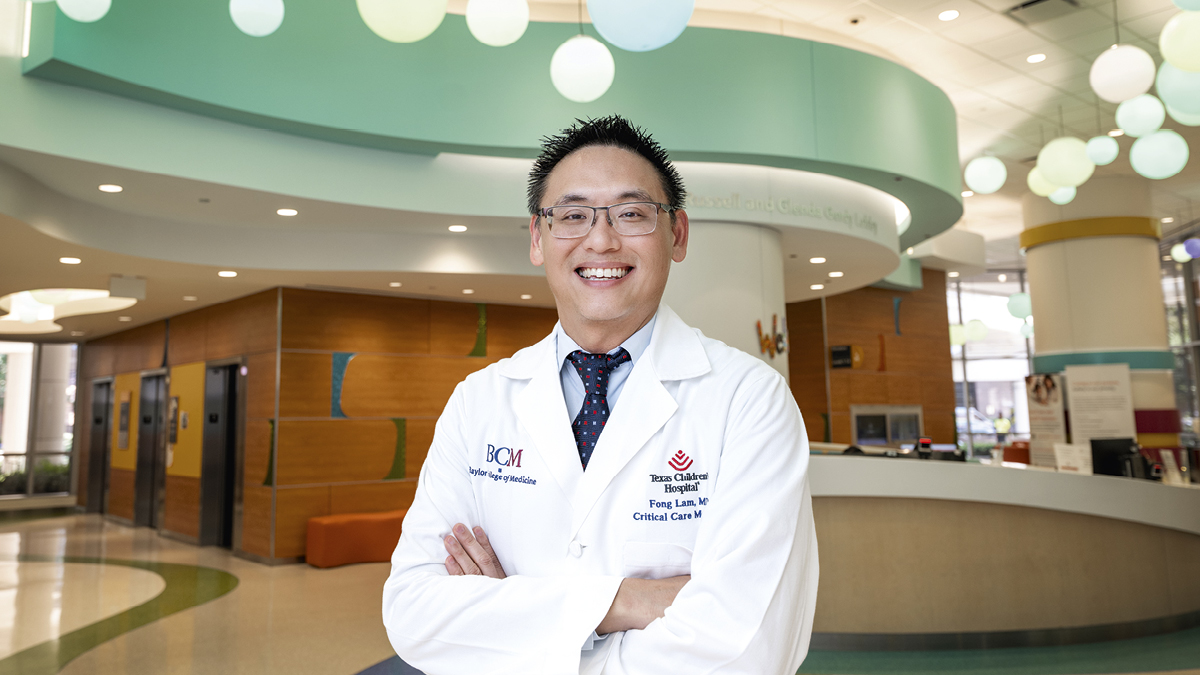
In the middle of the night, Fong Lam, MD, stood over a patient in the intensive care unit at Texas Children’s Hospital (TCH) in Houston. The patient had a new diagnosis of infantile leukemia and their white blood cell counts were off the charts, putting them at an extremely high risk for stroke and lung injury. For older patients, Lam and his colleagues would use a centrifuge machine to remove the white blood cells, but this patient was too small for the machine. Lam had to lower the white blood cell counts by hand.
For four hours, he and a pediatric critical care fellow used a central line that was hooked up to the patient to remove tiny amounts of blood, discard it, reinfuse the infant with red blood cells, platelets and plasma—and repeat the process until the white blood cells were at a safe level.
Lam is an associate professor of pediatrics-critical care at Baylor College of Medicine (BCM) who splits his time between intensive care at TCH, his research lab at the Michael E. DeBakey Veterans Affairs (VA) Medical Center in Houston, and teaching. That day, he had been up since early morning. He had spent the day in his lab before reporting to his nighttime call in the pediatric intensive care unit (ICU). When his call ended the next morning, he returned to his lab to analyze data. By the time he took a seat in a small lecture hall at the VA to hear from Sergey Shevkoplyas, PhD, a bioengineer from the University of Houston, it had been a long day.
The room was dark. Sunlight scarcely made it through the bunker-style slit windows, and the fluorescent lights were lowered for Shevkoplyas’s slide presentation. Lam served himself some coffee and took a seat toward the back of the room. As he listened, he kept thinking of the pediatric patient. The new device Shevkoplyas was describing could separate blood cells without centrifuges or other large machines. In some instances, gravity was enough to filter the blood through and separate it. “I could have used that last night,” Lam thought.
Shevkoplyas explained that the device could be useful for blood banks—they could receive blood donations and process them right away, separating blood into components such as plasma and other blood cells. Lam had other ideas: “Could you connect it to a person?” he asked. The engineer wasn’t sure.
After the presentation, Lam introduced himself to Shevkoplyas. He shared his idea for the device to be used as therapy for infants with leukemia. They exchanged contact information, left, and Lam started campaigning. He reached out to Shevkoplyas repeatedly over the next few months, following up every few weeks to see if they could meet. He was convinced the microfluidic device could help tiny leukemia patients.
Persistence in Pediatric Medicine and Research
If there’s one word to sum up Lam’s career and education, it would be persistence. From his days in Chinese school as a Chinese American student growing up in Texas—where he would copy columns of Chinese characters over and over until he got them right—to his repeated attempts to win National Institutes of Health (NIH) funding for his research, he often had to try and try again to achieve what he was after.
Lam’s path to science began in his father’s lab. A PhD researcher at BCM, his dad took Lam and his sister to his lab on Saturdays. Early on, Lam would entertain himself by playing the pinball game Midnight Magic on his dad’s Apple II while his dad attended to the lab animals. His dad was never glum about going to the lab on the weekend. “He loved research, and he made it fun,” Lam says.
When Lam was in high school, his dad ran a biotech company, and Lam worked in the company lab. He also worked with his dad’s colleague, a neurosurgeon studying stroke in rats. At the time, Lam planned to be a high school biology teacher. “I had a great one in high school, and I just wanted to be like her,” he says. His mom told him he should be a doctor, but he didn’t take the suggestion seriously until he was in college.
As an undergraduate at The University of Texas at Austin (UT), he volunteered in the pediatric arm of Brackenridge Hospital. Once or twice a week, he served as a clerk at the ICU’s front desk. He watched the doctors talk to families, deliver tough news, and explain what was happening with the patients. He hadn’t realized how much teaching doctors did or how much detective work was involved in the role. Suddenly, he liked the idea of becoming a doctor.
In 2003, after earning his medical degree from UT Southwestern Medical School in Dallas, he returned to BCM, first as a pediatric resident, then as a pediatric critical care medicine fellow. “When I looked around for fellowships in pediatric critical care, Baylor College of Medicine was the No. 1 spot for me because it had a combination of being a large clinical practice but also a very structured research platform, especially for medical trainees,” he says.
His clinical mentor at BCM, M. Michele Mariscalco, MD, MHA, emphasized the importance of research to improve patient outcomes and encouraged her trainees to deepen their knowledge of both human physiology and their individual patients.
“She did not let us talk about plans for patients until we saw every patient and we reviewed their charts, we knew all their labs, and we read all the previous day’s notes,” he says. “She had very high expectations of us.”
These expectations pushed Lam. He did extra reading to avoid embarrassing himself. Once, he brought what he’d learned from a recent paper to the ICU. Mariscalco let him try the technique but challenged him to explain why it didn’t work on his patients—and recommended more reading when he couldn’t provide an answer. “She had such a deep understanding of physiology that she knew what was safe to do and what was not safe to do,” he says, “and that gave me as a trainee … the autonomy to try things.”
When Lam decided he wanted to study microcirculation, Mariscalco introduced him to his first research mentor, Rolando Rumbaut, MD, PhD. Initially, Lam investigated capillary leakage, a condition in which fluid leaks from tiny blood vessels. But after a year, he pivoted to examining the role of platelets in neutrophil transendothelial migration, which is part of how the immune system fights infection. He published a paper on the subject, but his grant proposals were turned down.
By this point, his fellowship had ended, and he’d taken a role at BCM as a physician-scientist, where he worked in the ICU and had protected research time with startup funding. He started working with another mentor, hoping he’d land some federal grants, but before Lam gained much momentum, his mentor took a job in Seattle.
Lam decided to stay at BCM because there weren’t any junior faculty physician-scientist positions where his mentor was going and he was determined to do both medicine and research. It wasn’t until 2017, after he started working with Miguel Cruz, PhD, that he finally landed a federal grant.
“I had a very late start in my NIH career,” Lam says. “I don’t necessarily regret it because it taught me grit. And I was able to show myself I really want to do research.”
It also gave him time to sharpen his research questions through his experience in the pediatric ICU.
Teaching and Curiosity Shape a Physician-scientist's Work
Lam sees himself as a kid at heart and believes this childlikeness makes for a good scientist. “If you question everything like a 5-year-old … then I think you find the joys in trying to solve the puzzles and trying to understand why things happen,” he says.
As BCM faculty, Lam is expected to care for patients and do research and teach, but even if all three weren’t a requirement, Lam would embrace them anyway. His clinical work directly relates to his research. It shapes his questions and how he examines microcirculation and interactions between different parts of blood. His research, in turn, shapes his approach to clinical work, and his teaching brings it all together.
Since 2015, Lam has taught a flipped-classroom course called “Core and Applied Physiology” to residents and fellows at BCM, where instead of Lam lecturing, the students engage with material through assignments and in which more advanced students teach the more junior students. Over the course of a year, the biweekly sessions bring first-, second- and third-year residents together to learn from one another about different physiological concepts. The goal is to help them understand physiological processes so they will be better doctors and know how to navigate novel patient situations.
Lam’s favorite moments are when he sees fresh understanding dawn on his students. “Every couple of sessions—especially in the bigger or more complex ones—there will be at least one fellow or resident that sits there and says, ‘Oh! That’s why we do X, Y or Z,’” he says.
He wants to foster in his students the same curiosity that has driven his success. The same curiosity that led him to attend a lecture after a long day and make a new connection that might change patient treatments in the long run.
Turning Clinical Challenges into Pediatric Research Innovation
It took Lam a few months to persuade Shevkoplyas to meet with him, but his persistence paid off. Once they met, he convinced Shevkoplyas his idea was worth exploring. That was in 2017. Since then, they’ve investigated the efficacy of the device for removing white blood cells from both human blood and rats. Earlier this year, they published a paper in Nature Communications showing that the devices are safe in animals and can operate for at least three hours without losing function.
The devices, which use tiny channels roughly the width of a human hair to separate blood cells, are now being tested on pigs. Lam is hopeful the trials will go well and pave the way for a new, less-invasive therapy for pediatric patients with dangerously high white blood cell counts.
Will it work? Too soon to say. But one thing’s for sure: Lam won’t be sleeping on the possibilities.
This article was originally published in the November 2025 issue of The Physiologist Magazine. Copyright © 2025 by the American Physiological Society. Send questions or comments to tphysmag@physiology.org.
“I had a very late start in my NIH career. I don’t necessarily regret it because it taught me grit.”
The Physiologist Magazine
Read the Latest Issue
Don’t miss out on the latest topics in science and research.
Contact Us
For questions, comments or to share your story ideas, email us or call 301.634.7314.
6 Questions with Fong Lam
- What’s your best piece of career advice? Have perseverance or grit. I feel like I’m the poster child of perseverance with the amount of failures I’ve had.
- What’s your idea of happiness? Loving what you do, in professional and nonprofessional life. I have many hobbies. I love playing board games and running. And family’s really important to me.
- What do you like about treating kids? Kids are super cute. My favorite age patient is a five-year-old because they are so interested in the world, and they’re so inquisitive. To have that amount of wonderment is amazing.
- What’s a skill you’ve learned from working with biomedical engineers? Always keep an open mind and strive to learn new things. Ideas can come from anywhere.
- What talent would you most like to have? I would love to be a polyglot and know how to speak every language because breakdown in communications is probably 99% of the cause of every problem we have in the world.
- What’s your favorite thing to teach? Physiology, of course!