

6 Scientists Who Shaped Physiology
These legendary physiologists built the foundation for modern discovery. Their stories are scientific history—and make the future possible.
By Kavin Senapathy
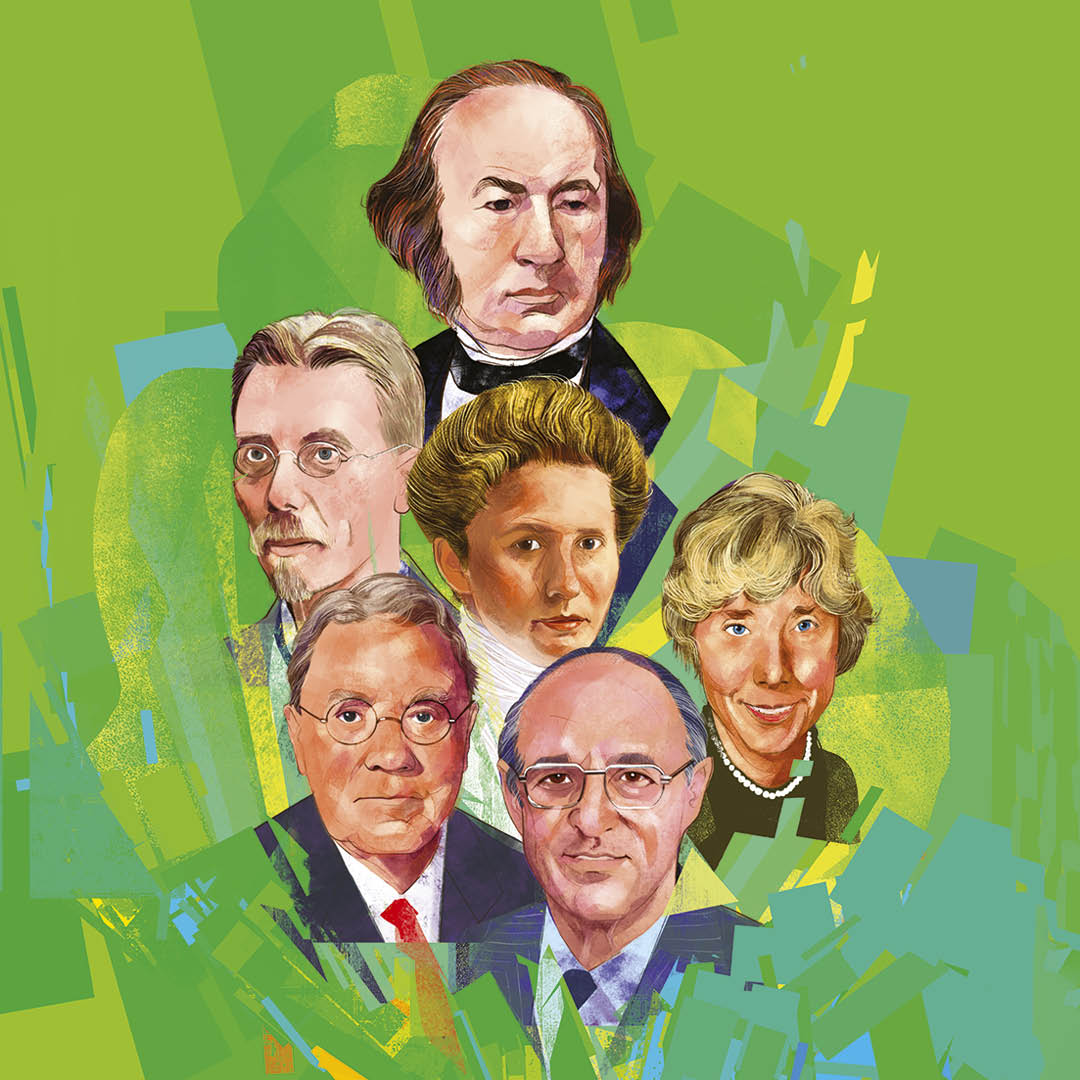
Physiology dates back to ancient scientists around the world, many of whose findings have been lost to history. Until the 19th century, humans had only an observational capacity to learn about the workings of living things. Then, a perfect storm of elements—like advancements in microscopy and chemical analysis methods and the proliferation of research laboratories—spurred a series of giant leaps for humankind. A group of legends harnessed that perfect storm, laying the foundation for modern physiology and for the physiology greats of the 21st century and beyond.
From discovering the concept of homeostasis to the complexity of cardiovascular dynamics, here are six pioneers who revolutionized the field of physiology.
THE FOUNDING FATHER
Claude Bernard (1813–1878)
While Claude Bernard may not be a household name like Charles Darwin or Louis Pasteur, he is to modern physiology and medicine what they are to evolutionary biology and microbiology. His findings, from how the nervous system regulates circulation to the fact that organs produce and secrete substances into the bloodstream, were as wide-ranging as they were foundational.
The Breakthrough
Bernard is best known for the concept of “le milieu intérieur,” which roughly translates into the internal environment of the body. The idea is that living things maintain a consistent inner state of equilibrium despite a dynamic external environment. That the organism has its own stable, regulated internal space separate from its surroundings seems obvious in modern times. It is, however, Bernard’s experiments that underlie the concept. Though he couldn’t have imagined its immense complexity, he understood that, in this internal scene, the cells and body systems somehow work interactively to maintain balance.
Why the Science Still Matters
The idea was the direct predecessor of homeostasis, a unifying physiological concept, and has “influenced everybody,” says APS Chief Science Advisor Dennis Brown, PhD, FAPS, a professor of medicine at Harvard Medical School and the 90th APS president. The question of how cells and organs maintain the body’s internal environment, and what goes wrong in disease, remains a vital driver of the field. Also remarkable was Bernard’s insistence on—and advocacy of—experimentation with controlled variables rather than observational studies alone. Without causal mechanisms, one cannot effectively treat disease, he posited in his seminal 1865 book, “An Introduction to the Study of Experimental Medicine.”
The Modern Connection
The standards he promoted— clear hypotheses, experimental controls and reproducibility protocols—seem basic to the modern scientist, but they weren’t always taken for granted. They are a central precursor to present-day grant review and methodology criteria. Modern systems biology, endocrinology, pharmacology and other subfields can trace their roots back to Bernard’s experiments.
THE WORDSMITH
Walter B. Cannon (1871–1945)
Building on Bernard’s milieu intérieur concept in 1926, Walter B. Cannon coined the term “homeostasis” to denote the constancy of the organism’s internal environment despite its often-hazardous surroundings. The word is a combination of the Greek “hómoios,” meaning “similar,” and “stásis,” meaning “standing still.”
The Breakthrough
Cannon, who served as the sixth president of APS, carefully selected the Greek term for “similar,” rather than the term for same, “homo.” This was to convey a subtle but key distinction: Homeostasis is not an unchanging or stagnant state; it’s a dynamic one. When an organism is doing well, its blood pressure, pH, body temperature and myriad other internal elements oscillate within a constant healthy range. One or more of the pieces of the unfathomably complex machine that maintains this equilibrium is thrown off in virtually any disease state.
Why the Science Still Matters
Homeostasis is considered a central unifying concept of physiology. Today, with technology that enables increasingly granular studies, down to the single gene and molecular level, it is largely beneficial to study the organism’s constituent parts—but it’s also important not to lose sight of the forest for the trees. In this sense, Cannon’s holistic view of homeostasis continues to influence physiologists to not only hone in on the tiniest puzzle pieces, but also to zoom out to the whole organism’s unified internal harmony.
At its essence, the concept is the basis for the “mindset of trying to understand how the body systems work together,” says John Hall, PhD, Arthur C. Guyton Professor and Chair at the University of Mississippi Medical Center and the 74th APS president. Current research questions about how the body maintains health boil down to homeostasis and the ways an organism can struggle to sustain it.
Cannon also coined the term “fight-or-flight” to denote the physiological responses he observed in animals when they experienced fear or other emotional disturbance. The concept remains part of the 21st-century zeitgeist, largely due to its sheer catchiness. Fight-or-flight is not exactly a technical term, explains Brown, but it has a “nice kind of alliteration” that continues to stick with laypeople.
The Modern Connection
Cannon learned at a very early stage that “the use of buzzwords is important,” Brown says. The concept highlights the perpetual importance of knowing “how to speak to your grandma” about science. Ultimately, Cannon’s popularization of physiology helped set the bar for the Society’s emphasis on science communication and outreach.
THE POWER COUPLE
August and Marie Krogh (1874–1949; 1874–1943)
Marie Krogh first met her husband, August, in 1904 while she was in medical school. This Danish couple couldn’t have known the extent to which they would eventually change the world.
The Breakthrough
August Krogh’s most famous work involves capillary blood flow. Before his time, physiologists assumed that capillaries were passive blood vessels that remained open, enabling a steady flow of blood. He upended that static view, showing that capillaries actively engage in dynamic blood flow regulation depending on the needs of tissues and organs. He was awarded the Nobel Prize in Physiology or Medicine in 1920 for this paradigm shift, which has since inspired generations of researchers and underpinned modern studies of microcirculation, exercise physiology, cardiovascular medicine and more.
Marie Krogh is probably best known for her instrumental role in promoting insulin as a therapy for diabetes, Brown says. As someone with diabetes, she epitomized the patient-researcher perspective. By the time she was diagnosed with the condition in 1921, she was already an accomplished researcher who collaborated with her husband on research into the mechanisms of gas exchange in the lungs. She was also a practicing physician.
Why the Science Still Matters
Marie Krogh’s 1921 diagnosis prompted the couple’s interest in insulin, which was first isolated from the pancreas of dogs that same year in Toronto, Canada. Shortly thereafter, Marie became one of the first diabetes patients to receive insulin. The Kroghs founded Nordisk Insulin Laboratorium (leading to today’s Novo Nordisk pharmaceutical company) and soon developed methods to scale up insulin production and distribution throughout Europe.
The Modern Connection
August and Marie Krogh’s legacy is largely a joint one. “She probably never rose to the scientific heights that he did” because of the sidelining of women in science at the time, Brown says. Still, he imagines Marie was “the power behind the throne.” Together, the couple “made a huge contribution to academic science, basic science, but also to clinical science as well, and to diabetes in particular,” Brown says.
THE TRAILBLAZER
Bodil Schmidt-Nielsen (1918–2015)
Perhaps best known as August and Marie Krogh’s daughter and as APS’ first woman president, Bodil Schmidt-Nielsen’s legacy extends well beyond her parentage and gender. She helped lay the foundations for comparative physiology, which explores how body systems across species are suited to their unique and often extreme habitats.
The Breakthrough
Schmidt-Nielsen’s most significant work was her illumination of how the kidney processes and eliminates urea. She and her husband, Knut, also a physiologist, collaborated to study an extensive range of animals. They unearthed how different species manage homeostatic salt and water levels. Many eminent physiologists, including Schmidt-Nielsen, went to Mount Desert Island off the coast of Maine because it enabled localized access to a variety of animals spanning the terrestrial, the aquatic and everything in between. She was a staunch adherent to her father’s “Krogh principle,” which posits that for every physiological process of interest, “somewhere out there in the wild is a creature that really does it well and that you can learn from,” Brown explains.
Why the Science Still Matters
Schmidt-Nielsen and her team were known to set out in search of frogs, seals, birds, insects and fish. Brown helps with a course on renal physiology at her former lab, now called MDI Labs, where he sets the scene for students of the famous experiments she carried out there. Ultimately, the creatures she studied across practically every genus—from frogs to insects to camels—expanded physiology beyond humans and lab rodents into an integrated approach involving whole ecosystems.
The Modern Connection
In addition to her groundbreaking research, Schmidt-Nielsen is celebrated for her mentorship. Though Hall didn’t know her well, in their interactions, he found her to be warm and kind, while also drawing the respect of her peers not only for her scientific contributions but her aptitude for leadership. The APS Bodil M. Schmidt-Nielsen Distinguished Mentor and Scientist Award continues to honor her legacy today by acknowledging a member of the Society who has made outstanding contributions to physiological research and demonstrated dedication and commitment to excellence in training the next generation of physiologists.
THE SCIENTIFIC GIANT
Arthur C. Guyton (1919–2003)
Known for his analytical mind, Arthur C. Guyton was a pioneer in applying large-scale systems analysis to create a mathematical model of the entire cardiovascular system.
The Breakthrough
Guyton amassed data on blood flow and pressure, eventually using analog computers to create an elaborate diagram of the web of factors that govern blood circulation. As his body of work grew, he shifted multiple paradigms. Before Guyton’s modeling, it was practically “dogma” that the physical ability of the heart to contract governs blood circulation, says Hall, who worked closely with Guyton for over 20 years.
By contrast, Guyton’s work showed that the needs of the tissues determine how much blood the heart sends based on how much deoxygenated blood returns to the heart in a given situation. For instance, the bicep of a gym-goer doing a curl will start using more oxygen. This results in increased blood flow to the muscle, which returns a higher volume to the heart, prompting it to continue increased supply to the bicep.
Why the Science Still Matters
Involving kidney dynamics, the endocrine system, nervous system control mechanisms, blood viscosity and a slew of other elements, the model has grown more detailed over time. But it’s not without its limitations, say some scholars, including that the heart may play more of an active, albeit limited, role. Nevertheless, recent studies in living patients have provided validation for his model, which is seen as the foundation for today’s understanding of cardiovascular physiology.
Also remarkable is the shift he spurred in the understanding of the dynamics of interstitial fluids. Before Guyton, researchers thought that tissues were passive in the distribution of the fluid system that permeates the body. Instead, he found that tissues are active—fluid pressure in some tissues, such as the skin and lungs, is negative and fluctuates to create varying suction that prevents swelling.
Guyton’s research also revealed the kidney’s central role in blood pressure regulation and illuminated the mechanisms behind it. This has made a lasting mark, informing treatments for many chronic and acute conditions.
The Modern Connection
Guyton’s legacy goes beyond his scientific accomplishments. He contracted polio as a surgical resident, causing extensive paralysis. The virus dashed his ambitions of being a heart surgeon—his family was full of lofty medical ambitions, as evidenced by his 10 children, all of whom became doctors. His disability prompted a change in his scientific trajectory but didn’t dampen his tenacity.
He was a teacher with a warm demeanor who trained around 150 physiologists. Guyton advocated for making information accessible and understandable, writing the seminal “Textbook of Medical Physiology” in 1956. He wrote the first eight editions solo, resulting in a cohesive, comprehensive tome that has likely influenced more medical students than any other physiology textbook.
In the years leading up to Guyton and his wife’s deaths in 2003 from a car accident, Hall partnered with Guyton to release editions nine and 10 of the book. Since then, Hall has assumed the mantle, releasing additional editions of the indispensable “Guyton and Hall” textbook.
This article was originally published in the September 2025 issue of The Physiologist Magazine. Copyright © 2025 by the American Physiological Society. Send questions or comments to tphysmag@physiology.org.
The Physiologist Magazine
Read the Latest Issue
Don’t miss out on the latest topics in science and research.
Contact Us
For questions, comments or to share your story ideas, email us or call 301.634.7314.