

Tracy Bale reflects on sex differences research and why engaging communities is essential for advancing brain health and translating science.
By Dara Chadwick
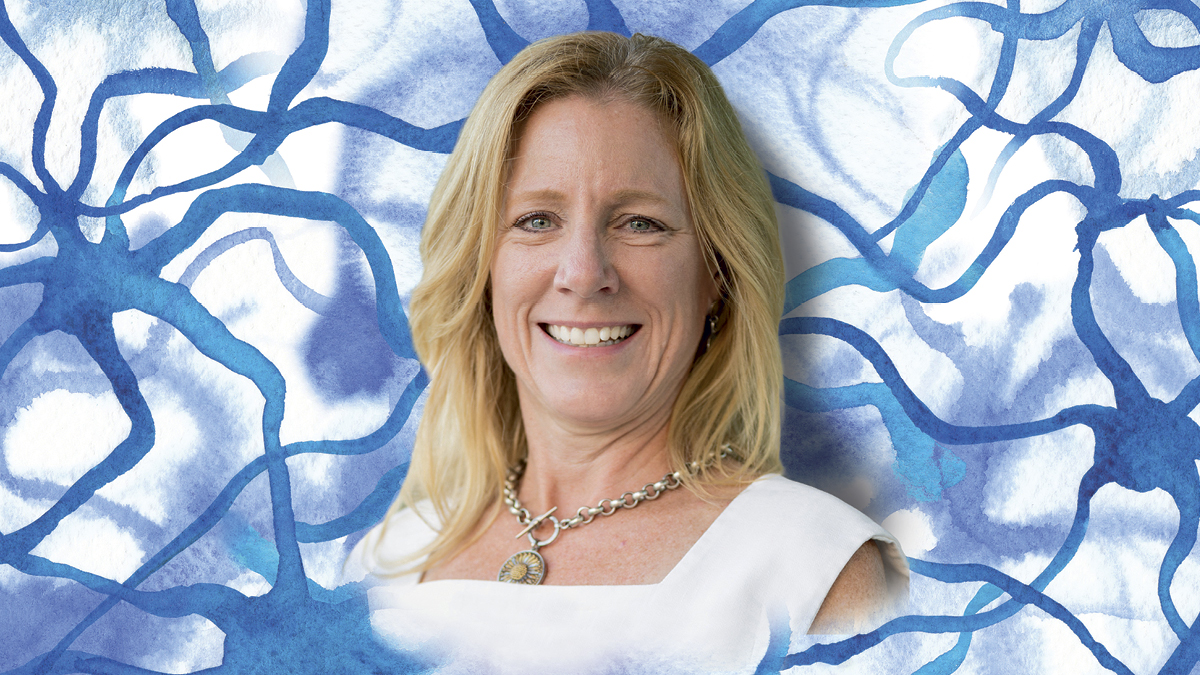
Tracy L. Bale, PhD, describes herself as a “basic neuroscientist.” Yet “basic” is hardly a fitting word for Bale’s career—or for her approach to building connections between science and the community.
She recently helped create a comedy and science showcase event in Denver called Headstrong Comedy, billed as a night of hilarious insights into what’s happening inside our overloaded brains. Bale paired four female comedians from underrepresented groups with four female scientists for an evening designed to “tackle misconceptions about women’s brain health.”
“I partnered the comedians with my science colleagues who I thought could pull off making science engaging and amusing,” she says. “The event sold out.”
Bale is the Anschutz Foundation Endowed Chair in Women’s Integrated Mental and Physical Health at the Ludeman Center, professor and director for InterGenerational Stress and Health, and director for sex differences research in the Department of Psychiatry at the University of Colorado Anschutz Medical Campus in Aurora. She is also the first woman president of the International Brain Research Organization, which was founded in 1961.
Bale classifies much of the work she does in the Bale Laboratory of Translational Psychiatry as physiology, adding that she is trained in neuroendocrinology, neurobiology and pharmacology. “We can’t separate the brain from the body,” she says. “Many neuroscientists spend their whole careers focusing on very limited parts of the brain. My research takes a step way back to focus on the integration of the brain and body. The immune system, the endocrine system—it’s all related. It’s all cellular responses.”
In April, Bale will deliver the opening keynote address at the American Physiology Summit. As she always does, she says, she’ll talk about sex differences. She’ll also talk about how physiologists can bring science into their communities and why it matters.
“It’s so important,” she says. “When you talk with colleagues, neighbors and community members about your work, it helps them understand how what we do affects things like drug development or treatment for their diabetes. When we don’t engage, people may have no idea. And when they understand, then when they’re voting, they can say, ‘I think what they’re doing is really important.’”
No Average Days
Bale grew up in Pine Island, Minnesota, a town of about 2,000 people. The town’s proximity to Rochester—home to the Mayo Clinic—created a culture steeped in science that helped drive investments in local schools, according to Bale. She had access to science classes such as zoology and physiology.
Her academic career began at Gustavus Adolphus College, a small liberal arts school in Saint Peter, Minnesota. She later transferred to Washington State University, where she earned a bachelor of science degree in molecular biology. She went on to earn a PhD in neurobiology in the Department of Pharmacology at the University of Washington and completed a postdoctoral fellowship in neuroendocrinology at The Salk Institute for Biological Studies in La Jolla, California.
Bale says she became fascinated by sex differences early in her career. She encountered research about how hormonal interactions impact brain function and was captivated by the questions raised. Her curiosity on the topic of sex differences has never waned.
“In everything we do, we ask if sex is a biological variable,” she says. “We make sure it’s incorporated in our study design, and we always look at it statistically to determine if there are aspects of differences in things like developmental windows, vulnerabilities and risk resilience. A lot of our focus is on the stress experience, and we see differences in stress responses between males and females in our mouse studies.”
She cites the placenta as an example of where stress differences are visible between males and females. Stressing pregnant mice and then removing the placenta reveals interesting information. “If you look at transcriptomics as an indication of how a male placenta and a female placenta responded to mom’s stress, you’ll see that the males experience massive changes. Females are more likely to sit tight, indicating ‘this is not something we need to respond to.’ We see similarities in humans, but alone, they’re just descriptive outcomes.
“What we don’t know is what it means to the male or female developing brain. There are a lot of ways a person might adapt physiologically. Maybe the male is going to respond differently across its lifespan than the female will because of differences that happened early in development. But just because you see a difference doesn’t mean it’s positive or negative. There are many considerations.”
Bale says her “love of the question” has been a driving force in her career. “There’s no such thing as an average day in the lab,” she says. “In science, hour to hour is never the same, much less day to day. I always remind my trainees that in every discovery, finding or hypothesis you test, for that moment, you are the only person in the world who knows that. That is so powerful. How many jobs can you say that about—you get to know something nobody else knows and you hold the potential?”
Science Meets Real Life
Bale says she’s extraordinarily passionate about psychiatric improvements to mental health. While discovery for its own sake is important in science, she says impact is what matters most to her. “At this stage of my career, discoveries need to have an impact on our quality of health and health outcomes,” she says. “My passion as a scientist, a human being and a mother is that we are not doing a great job with coming up with novel approaches to improve mental health. We need to push ourselves to take our science toward impact.”
One area of research that is ripe for impact and of great interest to Bale is biomarkers for psychiatry. “If you have cancer, there are a million different tests. What do we have for psychiatry? Nothing. You have a conversation with a psychiatrist or therapist, and their diagnosis is based on how you answer questions. But many psychiatric conditions directly affect your ability to observe yourself and relay that information. So, diagnosis can be difficult.”
Bale says she wants her research to provide information that can build better models for psychiatric biomarkers. “That’s where I’ve shaken up how I run my lab,” she says. “I tell my graduate students and postdocs that our projects aren’t only about getting grants and writing papers. I ask them, ‘Where’s the impact? How can we translate this better and faster?’ These are interesting ways to approach our science—it’s not only the discovery, but where that discovery can take us.”
Engagement Matters
Bale spent 15 years as professor of neuroscience at the University of Pennsylvania before she was recruited by the University of Maryland to develop the Center for Epigenetics Research in Child Health and Brain Development, which focused on building translational research. “We were in Baltimore, a majority Black city,” she says. “And I thought, ‘How are we going to do translational research that’s impactful and get community investment if the community doesn’t trust us?’”
She began working with different community partners, including members of the Baltimore City Council, to help them learn about the brain and its function.
“Trauma, particularly generational trauma, is a big word in majority Black cities,” Bale says, adding that partnering with policymakers with the power to shape laws was rewarding. “The mayor used to use the term ‘hurt people hurting people.’ It was an incredible opportunity to help the community understand more about the brain and develop language that could inform policies.”
But it was at Penn where Bale learned the importance of engaging communities with humor, empathy and understanding. “We did a bar night with scientists,” she says. “We focused on the microbiome, and each scientist gave an amusing talk on a different microbiome topic, such as the vagina, the armpit and the gut. It was fantastic science done in an engaging way. Oh, and interspersed was burlesque dancing.”
Creative approaches like these can help shatter the perception of scientists as elitist, Bale says. “Go to your synagogue, community center or your child’s school,” she says. “Go talk about the science you do. You’ll be amazed at how that can grow into understanding and support. How are people going to care about NIH if they don’t know what’s happening on campus?”
This article was originally published in the January 2026 issue of The Physiologist Magazine. Copyright © 2026 by the American Physiological Society. Send questions or comments to tphysmag@physiology.org.
“I always remind my trainees that in every discovery, finding or hypothesis you test, for that moment, you are the only person in the world who knows that. That is so powerful.”
The Physiologist Magazine
Read the Latest Issue
Don’t miss out on the latest topics in science and research.
Contact Us
For questions, comments or to share your story ideas, email us or call 301.634.7314.
Highlighting Sex Differences
Tracy L. Bale, PhD, will open the 2026 American Physiology Summit on April 23 with a keynote about sex differences in research and why it’s important for physiologists to talk about science in an accessible way in their communities. Register for the Summit.