

How Animal Models and New Technology Work Together in Research
From organ-on-chip to AI, researchers explain why animal models and new approach methodologies work best together to strengthen science.
By Dara Chadwick
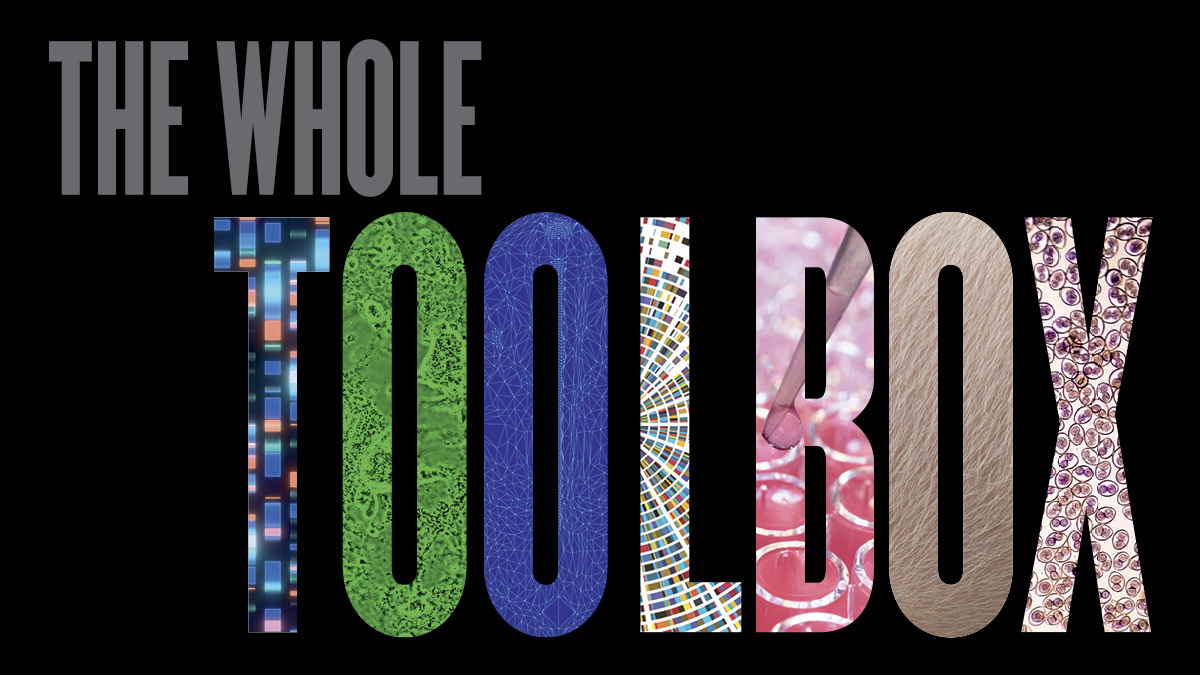
The right set of tools can make all the difference in the outcome of any job, including scientific research. Today, physiologists have more options than ever in scientific models. Many are embracing both animal models and emerging “new approach methodologies” (NAMs) in their quest to answer complex physiological questions. While traditionally NAMS has meant “non-animal models” and is often how scientists define the term, the National Institutes of Health has begun to use the term new approach methodologies.
Using multiple methodologies in complementary ways is strengthening scientific research. A combined approach helps researchers have more confidence in their findings and gives their findings more relevance than any single model may be able to do.
Caitlin Vonderohe, PhD, DVM, assistant professor at Baylor College of Medicine in Houston, Texas, studies the intestines of preterm infants, including those who develop necrotizing enterocolitis (NEC), a disease that develops in the first weeks of life. “Some infants who develop NEC have their small intestine resected and live with short bowel syndrome,” she says. “But in severe cases, the death rate is up to 50%. Despite the time and energy spent on this disease, we don’t know exactly why it happens.”
Vonderohe is working to understand how NEC may be both prevented and treated. She says that layering non-animal models into her existing animal model is unlocking new insights, such as why human milk—the gold standard for preventing NEC—works in this way. She’s also repurposing an adjunct chemotherapy agent that converts arginine in the blood into citrulline as a potential treatment. “It’s been really effective to prevent NEC in my model,” she says. “But we don’t yet know why it works.”
Vonderohe, a member of the APS Animal Care & Experimentation Committee, uses a preterm piglet model to explore these questions because they are predisposed to all the same diseases as preterm infants. She says they are able to recapitulate the clinical presentation of these infants. This allows her to study how nutritional interventions and drugs affect the development of different diseases that occur secondary to preterm birth.
She also uses NAMs to study prematurity and NEC. In her current project, she notes that the conversion of the amino acid arginine to a non-protein amino acid, citrulline, is effective at preventing NEC in the pig model. Her team also uses cellular models calledenteroids—which were cultured from biopsies, containing stem cells, of human intestine—to explore how amino acids affect inflammation in the gut.
“When you culture enteroids, they replicate all the cell types found in the lining of the small intestine,” she says. “We work with our collaborators to make our own mini-guts and co-culture them with other cells like hepatocytes and immune cells, depending on which cells we think may be bad actors and contribute to NEC in infants,” she says.
Layering her animal model with NAMs lets her team ask both fundamental and complex physiological questions about NEC and its potential treatments, Vonderohe says.
“Our animal models are so valuable because we can’t study preterm infants directly,” she says. “They’re so delicate and they’re physiologically different from infants born at term. It’s difficult to replicate that physiology in a petri dish.”
Complementary, but not interchangeable
Eric Lazartigues, PhD, FAPS, director of the Cardiovascular Center of Excellence and professor of pharmacology and neuroscience at Louisiana State University Health in New Orleans, uses both animal and non-animal models in his research. His laboratory studies how the brain controls the regulation of blood pressure through the autonomic nervous system.
Lazartigues uses a trans-genic mouse model to study the renin-angiotensin system. “We have animals that are either overexpressing components of the renin-angiotensin system in specific cells in the brain or are lacking receptors and enzymes within those cells,” he says. “By comparing animals and challenging them with protocols that elevate blood pressure, we can identify the role of these components in a cell-specific manner.”
The integrative model that animals provide is critical, he says. “You need a physiologically intact, integrative model when you’re looking at a system that impacts multiple organs. That doesn’t mean we’re not using other models that are more focused, but at the end of the day, we need to come back to the integrative model,” he says.
Lazartigues also uses NAMs, including cell cultures to learn about the mechanisms of neurons and microglia. His team co-cultures cells to see how they interact.
“The models have evolved,” he says. “Non-animal models now integrate more natural complexity. Co-culture first appeared years ago, and now there are multiple co-cultures available because people realize a single cell may not be as relevant as having multiple cells from different origins acting on each other.”
NAMs help validate signaling pathways and enhance the translational relevance of research. With more sources, researchers can feel more confident that their results are clinically relevant, Lazartigues says.
One challenge of having more options is determining which models are best to use. That depends on the question you’re trying to answer, Vonderohe says.
“For every research project, we ask if we are sufficiently powered to answer the question,” she says. “Can we get organoid tissue to first answer the question in a granular way? If the question persists, what type of pig experiment do we design around this?”
Animal models remain an essential component of physiological research, according to Robert Hester, PhD, FAPS, a past president of APS and semi-retired professor of physiology at the University of Mississippi Medical Center (UMMC). Animal models and NAMs are complementary, but they’re not interchangeable.
“The environment of a tissue in a cell culture lacks some aspects of the environment within the human body, such as the many hormones present in the human body,” Hester says. “You can learn how tissue works in a culture, but you have to look at how that tissue works in different environments.”
The growing role of machine models
Physiologists are also using scientific tools such as artificial intelligence (AI) and computational models. These tools help researchers integrate data, design experiments and simulate the variability of humans.
Hester has continued building on previous mathematical analyses of former UMMC Department of Physiology Chair Arthur Guyton and graduate student Tom Coleman to develop a computational model called HumMod. The model includes more than 9,000 variables related to cardiovascular, endocrine, metabolic, neural, renal and skeletal systems. The customizable Windows-based mathematical model simulates human physiology, enabling in silico clinical trials and digital twin creation.
It’s a valuable clinical training tool, Hester says. “You can have a patient start bleeding in virtual space and explore what to give them to stop it,” he says. “The model helps you understand the physiological consequences of different approaches.”
The model can also use an individual’s data to create a digital twin that shows potential physiological changes, as well as how the individual may physiologically respond to interventions. “The original purpose was to help researchers plan experiments to answer specific questions,” Hester says. “That’s still the value of the model for physiologists.”
Ryan Melvin, PhD, associate professor and principal data scientist in the Department of Anesthesiology and Perioperative Medicine at the University of Alabama at Birmingham, says his work includes high-resolution physiologic data, predictive analytics and generative AI.
As an example of high-resolution physiologic data, Melvin described an AI platform that captures signals from patient monitors at up to 500 samples per second. A predictive analytics model helps answer questions such as “Is this patient likely to come back?”
Most of Melvin’s generative AI work includes administrative and supportive uses, such as summarizing data and flagging weaknesses. While he sees enormous potential for AI tools in research, he also notes that large language models are not completely reliable. He’s optimistic about the potential of coding agents over chat-based AI tools in physiological research—particularly when it comes to experiment design.
“With AI, researchers could spend less time chasing experimental rabbit holes and help preserve resources,” he says. That’s because AI can work as a simulator to help with experiment design. If you only have the resources to do three experiments, you might simulate 10 experiments with AI and pick the three that show the most promise.
As for the safety of intellectual property when using AI tools? “I would be fine putting my million-dollar ideas into AI, but not my billion-dollar ideas,” Melvin says.
These are emerging technologies, and there are not that many experts out there, Vonderohe says. “It’s great to be on the cutting edge, but when we’re thinking about safety, it’s important to make sure everything is being validated properly,” she says. “Check your sources. Put your critical thinking hat on.”
This article was originally published in the July 2026 issue of The Physiologist Magazine. Copyright © 2026 by the American Physiological Society. Send questions or comments to tphysmag@physiology.org.
Understanding NAMs
NAMs or “new approach methodologies” are tools that use technology to expand research options for physiologists. NAMs include:
2D Cell Culture Models
Cells cultured in a single layer on a flat surface used to study specific cellular processes.
Primary benefits
These models offer a high degree of control, reproducibility and scalability. They typically require no special equipment, making them more cost-effective.
Limitations
These models deliver isolated results that don’t reflect the complexity of whole-organism interactions.
2D Co-culture Models
Different cell types are cultured together. Within 2D co-culture models, cells may interact with one another in different ways, depending on how the experiment has been designed.
Primary benefits
Cell signaling may occur in this model, allowing researchers to study essential cell functions and responses.
Limitations
Cultured cells function within a limited environment and don’t reflect cell behavior within a whole organism.
3D Cell Culture Models, Spheroid, Organoid
Cells cultured using a supportive structure, such as a scaffold, which allows cells to develop in varied directions and form structures that resemble organs.
Primary benefits
Researchers can replicate processes and environment within an organism, allowing cells to communicate and interact within the model.
Limitations
Model methodologies vary, making standardization difficult. These models are also expensive, require specialized equipment and have limited scalability.
Microphysiological Systems, Organ-on-Chip
Microfluidic cell culture devices that function as 3D human organs, containing varied cell types and incorporating microfluidics to simulate physiologic conditions.
Primary benefits
These models show how cells and tissue behave and interface within a specific physiological environment.
Limitations
Organs-on-chip can be complex, costly to create, difficult to scale and don’t contain all the cell types involved in organ function.
Computational Models, Digital Twin
Computer models that simulate an organism’s biology and physiology. Using these models, physiologists may study disease progression and treatment.
Primary benefits
Computational models allow physiologists to simulate cellular mechanisms and test physiological scenarios without animal studies or human subjects.
Limitations
Computational models are limited to representing biologic processes that are already known. Determining appropriate parameters can be challenging, and validating computational models requires technical expertise.
Data Mining
Analyses of large datasets to find patterns, identify relationships between variables and make predictions.
Primary benefits
Mining large datasets allows physiologists to study patterns and variables across millions of samples, increasing research speed and reaching beyond results of isolated experiments.
Limitations
Large datasets can create information overload in identifying which data are relevant to a specific research question. Data quality and validation of models are also concerns in using these tools.
The Physiologist Magazine
Read the Latest Issue
Don’t miss out on the latest topics in science and research.
Contact Us
For questions, comments or to share your story ideas, email us or call 301.634.7314.