

From the Lab to Leadership: Meet APS' New CEO
Erika Shugart, PhD, FAAAS, earned a PhD in biology before building a career in science communication and policy.
By Amanda Bertholf, MA
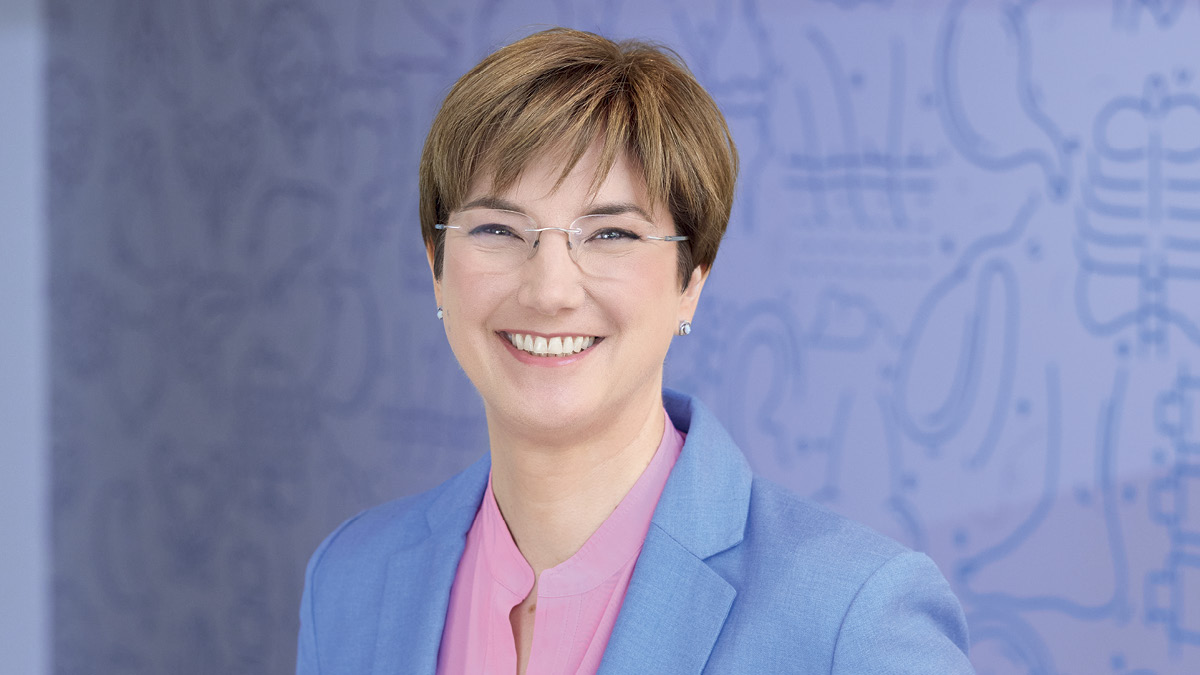
Erika Shugart grew up in Oak Ridge, Tennessee, a town built for science. Originally established as a production site for the Manhattan Project, it has been home to world-class research ever since. Shugart’s father was an ecologist. Her friends’ parents were scientists. Dinner table conversations revolved around birds and animals and environmental science.
It wasn’t until her family moved to Charlottesville, Virginia, when Shugart was in high school that she realized most people didn’t grow up this way. “I honestly thought, when I was a kid, that everyone wanted to be a scientist,” she says. “I thought that was the preferred career path, and suddenly I realized, oh, people want to do different things.”
Shugart, PhD, FAAAS, never strayed from science. Today, she is the CEO of APS, a role she stepped into in March, after the retirement of Scott Steen, CAE, FASAE. She brings more than two decades of leadership experience across the scientific society landscape, a PhD in biology from the University of Virginia, and a career spent doing something she considers just as vital as the science: connecting the world outside to what happens in the lab.
The Physiologist Magazine sat down with her in early April, about 30 days into her tenure.
A Different Path
Despite knowing she wanted a career in science, midway through graduate school, Shugart pivoted. She realized the life of a research scientist, at least in the form her graduate work was taking, was not the life for her. The frustration caused by dealing with experiments that didn’t work and uncertain timelines wasn’t a fit for how she was wired. Shugart wanted to work with fixed endpoints and clear outcomes.
So, she started looking at what else she could do during a time when conversations around alternative careers in science were taking shape. She began blogging about exploring different career paths, and two areas kept calling her: science policy and science communication. Both, at their core, were about the same thing. “I wanted to help connect science to society,” she says, “because I felt that is essential for a well-functioning society.”
Shugart finished her PhD and landed an internship at the National Academy of Sciences working on science communication about science policy. It was, she says, the perfect combination of her interests. From there, she built a career that took her through the Marian Koshland Science Museum of the National Academies, the American Society for Microbiology, the American Society for Cell Biology (ASCB) and, most recently, the National Science Teaching Association (NSTA).
Her graduate research was about as focused as science gets. “My thesis—understanding transcription during growth regulation—was like looking at one transcriptional regulator,” she says. “Very, very focused.” It was exactly the kind of reductionist work that defines much of biological science, breaking things down to their smallest parts. What draws her to physiology now is the opposite. Her brain, she says, sees larger patterns—how things fit together—rather than individual pieces. “That aligns with how physiologists view the world,” Shugart says. “Physiology takes those pieces and puts them back together into a bigger whole—a larger understanding of what’s going on in the human body and our health.”
Her background feels more relevant now than at perhaps any other point in her career. Science sometimes stands apart from the rest of society, Shugart says, treated as something outside of culture, when in fact it shapes nearly everything. “Making sure the public can access high-quality, dependable information—that we continue to make new discoveries because there’s so much we don’t know—is important,” she says.
A Natural Match
Shugart had been watching APS from a distance for years. Her first CEO role was at ASCB, an association housed in the same building as APS headquarters. She crossed paths with previous APS leadership and knew the Society’s reputation. “APS was on a list of places I’d love to work,” she says. But the timing had never aligned. When Steen took the role in 2018, she was early in her ASCB tenure. Then she moved on to NSTA.
After leaving NSTA, Shugart spent a year doing interim and consulting work, actively searching for her next scientific home and interviewing with several organizations. Then came APS. “When I was having conversations with the Search Committee, I realized how much it was a good fit personality-wise,” she says. “The conversations flowed. It was a dialogue. It didn’t feel like an interview. I walked away from each interview more excited about the organization.”
The more she learned, the more confident she became that she could make a real difference. Shugart saw APS as a society with a strong publications portfolio, an engaged membership and exciting emerging areas—meetings, professional development—where her experience was directly applicable. “I was just thrilled when I got the offer,” she says.
Shugart says when she arrived, what she found more than confirmed what she had anticipated. APS membership has a culture that isn’t a given in the association world; culture can vary widely from organization to organization. What struck her most in her early conversations with board members and volunteers is how much they feel like APS is their professional home. They built their community with the Society, many joining during graduate school. “They’re gracious with their time,” she says. “It’s been wonderful to engage with members who care so deeply and have a strong sense of community.”
The First 90 Days
Shugart describes herself as a deliberate onboarder. So deliberate that she has spent several years on a side project interviewing fellow CEOs about how they navigated their own transition; it’s research for a book she’s writing on the subject. “I’ve thought about how to do this well,” she says. “It’s been interesting putting it into action. Some of my plans have worked great, and in some cases, I didn’t do what I intended to do.”
To get started, she mapped her first months of onboarding into a plan. The initial 30 days were devoted almost entirely to listening: conversations with APS Board members, section chairs, journal editors-in-chief and APS staff. In April, the American Physiology Summit gave her a chance to hear from members directly and see the community in action. The next phase of onboarding involves external stakeholders and a deeper review of background materials, leading into a July board meeting where Shugart plans to begin shaping a shared direction with APS leadership.
“It works out nicely to have that opportunity to do the learning, then sharing, then discussion—not just a unidirectional conversation,” she says. “I listen, then I have a chance to share and get reaction and then listen again.”
That approach is intentional. Shugart acknowledges that she tends to draw conclusions quickly, so she’s mindful to pump the brakes. “It’s just like the scientific method,” she says. “You come in, you see some information, you make an educated guess, you form a hypothesis, but then you’ve got to stop and think: Let me make some more observations.”
She is also candid about what kind of leader she is and isn’t. “There’s an expectation that leaders are going to lead from the front, have a big flag and say, follow me,” she says. “That is not the kind of leader I am.” What she practices instead is servant leadership, a leadership philosophy that prioritizes the needs of others and emphasizes shared decision-making.
Meeting Members
Early conversations with members have surfaced both concerns and a desire for alignment. The concerns, Shugart says, are widespread and real: federal funding challenges, policy decisions and the sense that physiology is being sidelined or folded into a broader category of biological science.
The biological science societies, she says, are a fractured group—a wide Venn diagram of overlapping membership across many organizations, where the same researcher may identify as a physiologist one day and a cell biologist the next. She is assessing what that means strategically for APS, but her instinct points toward the Society as a convener across disciplines. “Physiologists are the uniters across the biological sciences. How do we help APS become that thought leader? That’s an opportunity for us.”
Members have also expressed their thoughts to Shugart on how the Society could extend its international presence, reach basic science researchers who may not have a home elsewhere, and sustain the momentum of the Science Life Depends On campaign. Seeing APS’ work on Capitol Hill land with a positive reception gave her confidence. “We’ve already taken a key step in explaining the importance and centrality of physiology,” she says.
Major Moment for Science
Shugart is excited to continue the work and carry the momentum from the Science Life Depends On Capitol Hill Day briefing and science fair. She knows it is a long and critically important fight.
“The U.S. still drives science worldwide,” she says. “Our science is second to none because of the huge federal investment that has been made, going back to the 1940s. Vannevar Bush’s ‘Science: The Endless Frontier’ laid out an agreement that the federal government is going to support science and that science is going to support our nation and the world.”
Scientists, Shugart says, have upheld their end of that agreement. “People live longer, people are healthier, and we’re safer. There is almost nothing in this world that isn’t better for humans because of the work science has done.”
The case for investing in science is clear. “For every dollar spent on science, we get multiple dollars back into the economy,” Shugart says. “We are a driver of positive economic growth. We need the government to continue to hold up their end of the bargain.”
Her approach to advocacy reflects her science communication background: finding shared values, standing on common ground and keeping the conversation going. Congress has shown bipartisan support for research funding, she says, and that matters. “We just need to continue to align with our values and take steps to make the case on the Hill, with people at all levels. That’s the chance to make a difference.”
Shugart also sees this moment physiology is having as an opportunity that APS cannot allow to pass by. GLP-1 drugs, Alzheimer’s research, omics—physiology is at the center of the biggest health stories in current events. But when you ask the average person, or even a policymaker, to name the science behind those breakthroughs, they’re likely to say “biology” or just “science.”
“We need to make physiology a household name,” Shugart says. Just like astronomy is the understanding of space, physiology is the understanding of the systems of our body, and how they all work together. It’s a brand issue, and we can work on the brand.”
What Members Should Know
When asked what she hopes members take away from her first 30 days, Shugart’s answer is immediate: that they’ve been heard. “You can be talked at, and it doesn’t mean the person hears you,” she says. “I want them to know that they have been heard. I’ve really taken what they’ve said to heart.”
The second thing she hopes APS members feel is optimism. She hears the worry in these conversations, and she understands it. But she also sees something else: a community pulling together and people showing up for each other.
While still in the early days of her role, Shugart knows there is a lot of work ahead of her. But her direction is clear: Listen, build trust, and when it’s time to move, move collaboratively. She also takes author Anne Lamott’s advice for tackling big tasks to heart: When the task in front of you feels overwhelming, take it bird by bird. It hits close to home, Shugart says, because she’s also a birder.
This article was originally published in the July 2026 issue of The Physiologist Magazine. Copyright © 2026 by the American Physiological Society. Send questions or comments to tphysmag@physiology.org.
5 Things Not on Erika Shugart’s Resume
From cloud forests to lumpy pots, here’s Erika Shugart in her own words.
Favorite place to visit. My father’s work took our family abroad, including to Australia. On the border between Queensland and New South Wales sits Lamington National Park, and just next to it is a private retreat called O’Reilly’s, nestled in a cloud forest. The birds there are extraordinary—bowerbirds, giant parrots that fly down and eat right from your hand. My biggest dream was to bring my own kids there someday. A couple of years ago, I did. Watching them experience the same delight I had as a child, feeding the birds, hiking the trails, made it one of my favorite trips.
Best piece of advice. My father told me when I was in my 20s, when I was agonizing over a decision: Get the best information you have, make the decision, and then walk through that door and don’t look back. That has stayed with me ever since.
Hidden talent. I’ve been doing ceramics for almost a decade now, both hand-building things and throwing pots. It was a wonderful and horrible initial experience because I wasn’t very good, and it can be hard to get right, especially on the wheel. It reminded me of what it’s like to be an early learner. There were a lot of lumpy, bumpy things that I made for a long time. At this point, I’ve made a whole dinner set, large-scale vases … and am continually improving.
Historical figure you’d invite for dinner. Eleanor Roosevelt. When I think back about the period when she was first lady, this was in the middle of the Great Depression. People weren’t happy about the way things were going. But she was this incredibly bright, talented leader who did amazing things within the constraints that society had her in at the time.
Three traits you value in a colleague. Curiosity. If you’re dealing with somebody whose mind is closed, or who’s uninterested, it’s hard to connect, especially if you have differences. Honesty. Knowing I can trust them, because if you don’t have trust, communication is difficult. Sense of humor. Things go wrong, things happen, and to be able to laugh and find the humor in all sorts of circumstances is a great trait to have.
The Physiologist Magazine
Read the Latest Issue
Don’t miss out on the latest topics in science and research.
Contact Us
For questions, comments or to share your story ideas, email us or call 301.634.7314.