

Why This Scientist Has Spent 40 Years Studying the Kidney
David Pollock, PhD, FAPS, now leads APS' journal Function and still finds the kidney fascinating.
By Melanie Padgett Powers
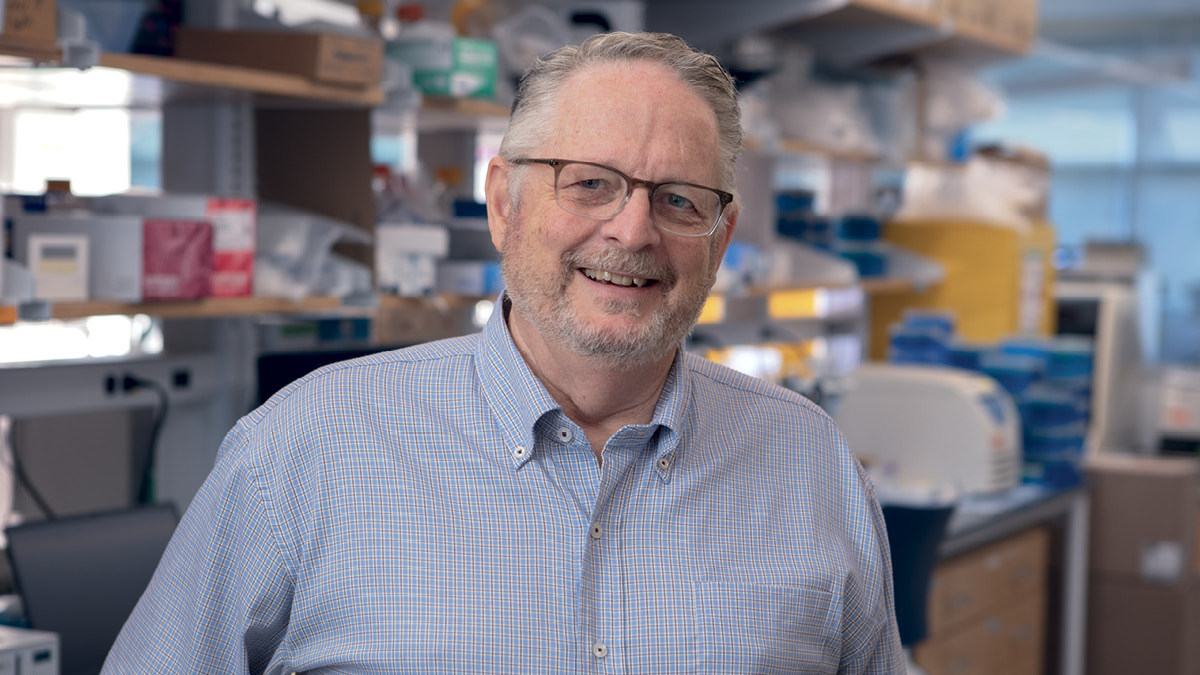
“Your kidney is just 0.5% of your body weight but receives nearly 25% of your cardiac output. And did you know the kidney also controls blood pressure?” Renal physiologist David M. Pollock, PhD, FAPS, explains kidney function as a great professor does, with the expectation you’ll find it as fascinating as he does. Unlike the brain, he says, the kidney reveals its function through its structure. Just by looking at it, you can understand the logic of filtration and regulation.
A leading renal pathophysiology researcher, Pollock has spent more than 40 years advancing our understanding of the kidney. Pollock is the James A. Schafer Professor of Medicine and co-director of the Cardio-Renal Physiology and Medicine Section at the University of Alabama at Birmingham (UAB). He is an APS past president (2014–2015) and is the editor-in-chief of the APS journal Function.
Growing up in Indiana, Pollock didn’t know he would become a scientist. He was interested in a lot of different things, including music, woodworking, basketball and other sports. But he was skinny and not so tall, so instead of playing a team sport, he became an athletic trainer. That introduced him to physiology, though he might not have called it that yet.
At the University of Evansville in his home state, most of the science majors talked about heading to medical school. But that didn’t interest Pollock. Like with so many origin stories, it was a teacher who made the difference.
“I found physiology,” Pollock says. “I had a really nerdy, goofy professor. Some people didn’t like him, but I thought he was kind of cool. He taught medical physiology. We used Guyton’s textbook for our undergrad class—it was a big, fat textbook. And I loved reading that book. It was easy to read, and I found it fascinating.”
Pollock had found his major. After graduation, he continued his physiology education at the University of Cincinnati, where he earned his PhD. That’s where he discovered his research focus. His PhD adviser was interested in salt regulation, and that passion rubbed off on Pollock.
Early in his career, Pollock worked at Abbott Labs in Chicago, setting up models of kidney disease. But when the company decided to stop their hypertension research, the higher-ups wanted to move Pollock to another division. He realized he didn’t have much control over the big picture and no longer wanted to work based on market decisions.
He and his wife, Jennifer Pollock, PhD, FAPS, a fellow physiologist, decided to return to academia. They were both offered tenure-track positions at the Medical College of Georgia, where they stayed for 20 years before moving to UAB.
Diving into Kidney Research
Back in academia, Pollock first focused on the endothelin. He thought to himself, “There’s lots and lots of endothelin in the kidney, and we really don’t know that much about what it’s doing there.” His lab later uncovered how endothelin regulates renal handling of high-salt diets and important preclinical evidence for use of endothelin antagonists in the treatment of several types of kidney disease.
At UAB, much of his work has focused on how the kidneys are affected by circadian rhythms—including blood pressure control and end-organ damage. His research includes collaborations with several other UAB labs also studying circadian rhythms.
Pollock’s interest in circadian rhythm was piqued while measuring blood pressure in rats through telemetry. By implanting small radio transmitters in the animals, the lab could monitor blood pressure 24/7.
“Normally, blood pressure is higher during the day and goes down at night, and if it doesn’t go down at night, it’s bad,” he explains. “When you get salt-sensitive hypertension and dysfunction in this endothelin system, the rhythm and blood pressure are much bigger. They’re very hypertensive, but the rhythm gets bigger too. So the day-night difference gets bigger. And I always wondered what would cause that.”
Enter the circadian rhythm. “We know that the molecular clock in the cells within the kidney are what keep it rhythmic,” he says. “You always will excrete more salt during the day versus night, no matter when you eat it. So if you eat salt at night, you hang on to it and get rid of it the next day. If you eat it during the day, you get rid of it that day. So the time at which you take salt in is going to affect how quickly it comes out. And this is related to the endothelin system.”
His current research includes examining time-restricted eating. Obese mice will develop renal fibrosis over time. But Pollock and his collaborators have shown that time-restricted feeding—only giving them food during their active parts of the day—eliminates the kidney fibrosis and improves blood vessel health. In contrast, feeding mice only when they should be sleeping contributes to kidney and vascular fibrosis.
In humans, time-restricted eating should not be confused with intermittent fasting, Pollock says. Time-restricted eating is restricting food to only a short period of six to eight hours during the day. It also doesn’t focus on reducing caloric intake, but instead, on improving your metabolism.
“A lot of this is tied to the biological rhythms of all your physiological systems—your liver, your gut, your heart, your brain. They all have a rhythm. And at night, they’re supposed to rest, repair and sleep. Your blood pressure goes down. But if you’re up, moving around, doing stuff like looking at screens and eating, you’re making your digestive system, your brain, your heart, work when they are supposed to be resting. Your physiological systems are not designed to function that way constantly,” Pollock says. “So, we are trying to figure out what causes health risks with our modern 24-hour society.”
Taking the Helm at Function
In 2026, Pollock became the editor-in-chief of APS’ Function, which publishes major advances that extend physiological mechanisms in the understanding of biology and the changes associated with disease states.
Function was launched in 2020 as an open access journal with Oxford University Press. This year, APS brought Function in-house, assuming full publishing operations. This strategic shift allows APS to continue strengthening Function’s position as a leading open access journal for physiology and enhancing the publishing experience for authors, reviewers and readers.
“A lot of what I view Function as is connecting physiology to the rest of the scientific world,” Pollock says. “Function provides an incredible opportunity to bridge the gap between all this awesome science that’s going on out there—the technique based, the different disciplines—and bring it back to the complex biological system.”
Function offers a venue, he says, for physiologists to connect their research to the broader scientific community, as well as for the researchers who may not consider themselves physiologists but who are conducting physiologically relevant research.
This is also an important time for physiology to continue to elevate its importance across fields, to lawmakers and to the greater society, as stable funding has diminished and scientific attacks have increased. Pollock argues that if you ask any hospital physician what the most important scientific discipline is nearly all would say “physiology” because it’s so critical to medicine.
He focuses on that relevance whenever he is reviewing papers or grants, asking himself, “Why should I care about this?”
The answer? “I care about it if it tells me something about improving the human condition. That’s exactly what physiology can do.”
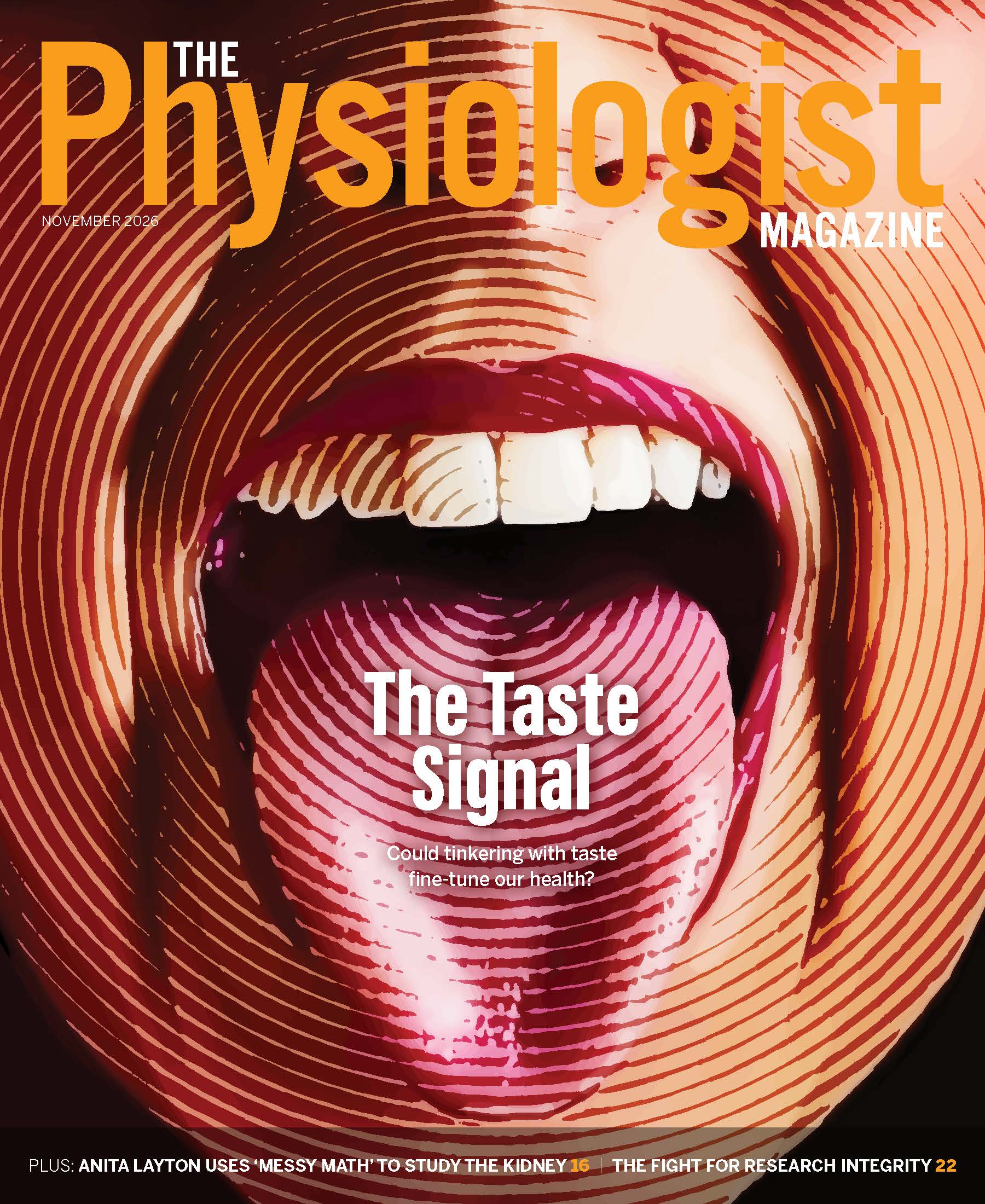
This article was originally published in the July 2026 issue of The Physiologist Magazine. Copyright © 2026 by the American Physiological Society. Send questions or comments to tphysmag@physiology.org.
6 Questions with David Pollock
What’s your best piece of career advice?
Don’t let the highs and lows distract you. Keep calm and do science.
You’re an amateur woodworker. What has been your favorite piece to make?
A dining room table out of reclaimed lumber.
Tell us about your love for music.
I like all kinds of music. We went to the symphony last weekend. We went to Nashville and saw Pat Metheny, a jazz guitarist. My very favorite is Steely Dan. And I love singing. I’m in the church choir, and I’m a baritone in the church chamber chorus.
What do you like to read when you’re not reading research papers?
I read biographies, and I like nonfiction like “Drive” by Daniel Pink. I read “Rigor Mortis: How Sloppy Science Creates Worthless Cures, Crushes Hope, and Wastes Billions,” which is something APS folks should read.
What do you do to de-stress?
My wife Jennifer and I like to watch British detective shows on BritBox.
What’s a fun fact about you that people don’t know?
NBA legend Larry Bird spent the night at my house one time at the University of Evansville. He was looking for a smaller school after leaving Indiana University, and my college roommate was a friend of his from high school.
The Physiologist Magazine
Read the Latest Issue
Don’t miss out on the latest topics in science and research.
Contact Us
For questions, comments or to share your story ideas, email us or call 301.634.7314.