

A practical guide to preparing for, attending and following up after scientific conferences to build collaborations, sharpen ideas and advance your career.
By Brian Busenbark
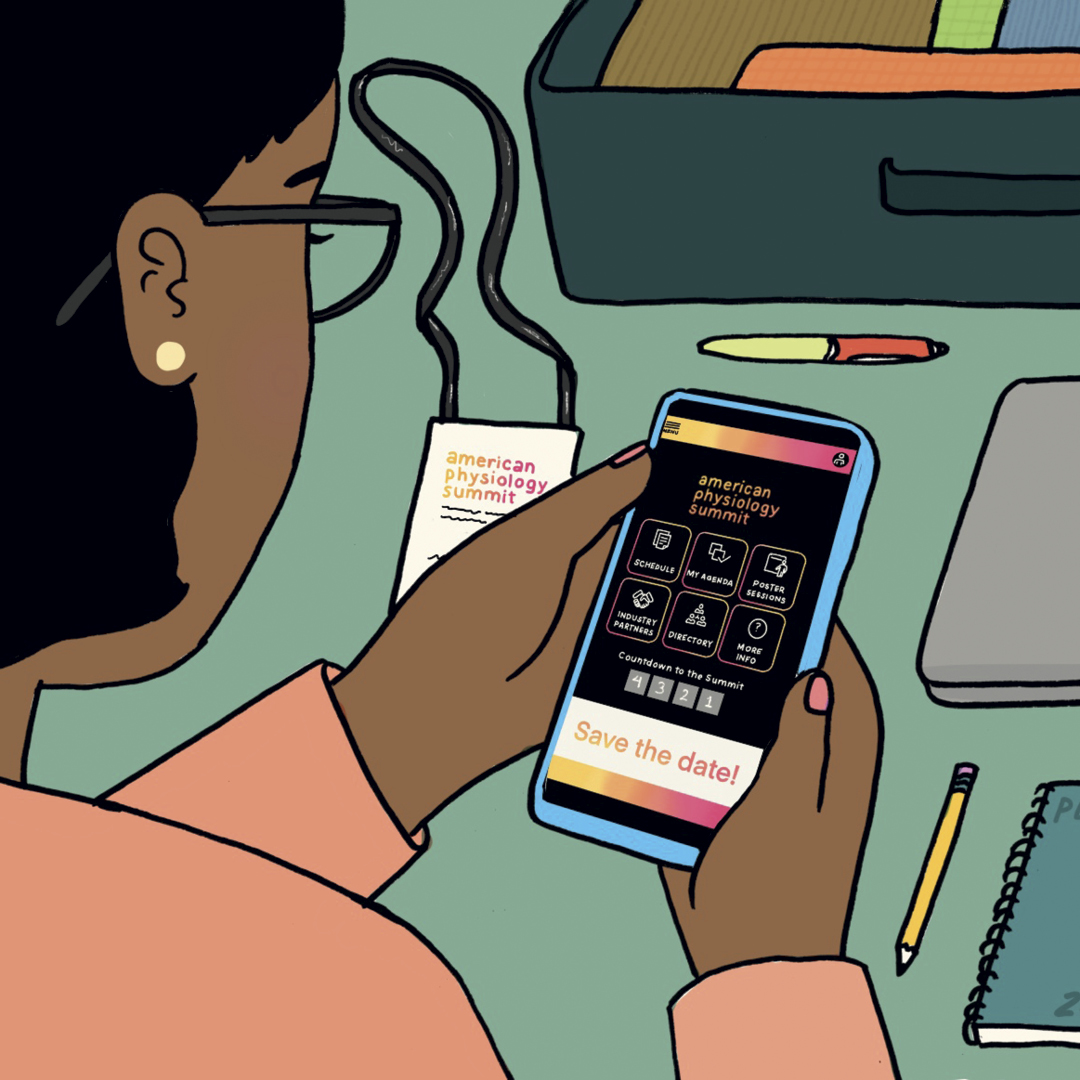
Technological advances continue to make remote work and virtual collaboration more and more convenient, but one holdover of intrapersonal business continues to thrive: the professional conference. According to an Events Industry Council study, conferences attract about 251 million attendees each year in the U.S.—with no signs of declining.
For physiologists, the benefits of attending an academic conference are undeniable.
“I’ve met people at these meetings who I’ve ended up collaborating with, have been advisers for me, and have provided lots of great scientific input,” says Hilary Coller, PhD, professor of molecular, cell and developmental biology at the University of California, Los Angeles. “I’ve gotten ideas at conferences that have impacted the direction of our work, and some of those conversations have changed the course of my life.”
How can you realize life-altering results like these and maximize the value of your next conference? It all begins in the weeks before you slip that badge and lanyard around your neck.
Before: Plan Intentionally
You’ve registered for the conference and booked your travel arrangements. Now it’s important to lay the groundwork for a successful conference. Here are some things to consider.
Build your personal agenda
When she was a PhD student, Lindsey Ramirez, PhD, used to walk into conferences believing she needed to attend as many sessions as possible. But at her first major APS meeting, she realized the sheer volume of events made on-the-fly decision-making stressful. So, she built a simple solution: an Excel spreadsheet.
“I copy over every single thing I’m going to do,” says Ramirez, a postdoctoral fellow at the University of Illinois-Chicago. “All my sessions, all the social events, mentoring meetings, poster sessions—everything. Seeing the entire conference laid out helps me stay organized, and I’m much less stressed.”
Whether you rely on a spreadsheet, a notes app, a printed schedule or a digital calendar, the goal is the same: to see your time clearly. Many conferences, including the American Physiology Summit, offer mobile apps that let you build a personalized schedule, browse sessions and receive real-time updates about events.
Whatever tool you choose, be sure to map the full picture of your meeting, including details many people forget—meals with collaborators, section meetups or time blocked for your own poster session.
Once you’ve figured out the logistics, step back and think strategically about how you want to spend your time. In building your conference schedule, be sure to explore topics outside your field of expertise. “Don’t go just for the low-hanging fruit,” says Nicholas Zachos, PhD, associate professor of surgery at Vanderbilt University Medical Center and APS Scientific Program Committee member. “Think more broadly. You may not realize how closely related your work might be to someone else’s in a tangential field.”
Identify who you want to meet
Effective networking is integral to a successful conference, and planning ahead to arrange those meetings is key. If an attendee list is not available, consult colleagues or mentors to determine if people you’d like to meet will be on hand. Once you’ve identified potential contacts, email them to secure time on their conference calendar. “Ideally, you’ll reach out about three months in advance, but at least one month,” Zachos says.
Critically, he says, tell them why you want to meet. “Give them a reason. Maybe you need a reagent, want to learn a protocol or want advice on a particular finding,” Zachos says. “Specificity matters. People want to know the conversation will be worthwhile for both of you.”
Set your goals
It’s critical to define what a successful conference means to you. What do you want to learn and, conversely, share? Who do you want to meet? The goals can be scientific, practical or career-focused, such as:
- Learning a new method.
- Exploring a different subfield.
- Meeting potential advisers.
- Connecting with mentors or collaborators.
- Discovering funding or service opportunities.
Setting goals helps you navigate meeting choices and create an elevator pitch to use to introduce yourself.
Prepare your story and polish your presence
Even if you’re not presenting, you’ll introduce yourself countless times. Prepare a 20-second version of who you are and your area of research. For poster presenters, the process of preparing your poster doubles as intellectual preparation. “It forces you to think through the logic of your project,” Coller says. “And at the meeting, the questions people ask help refine your narrative.”
Ramirez also encourages attendees to do a light tune-up of their online profiles. “Make sure your photo, affiliation and research areas are up to date,” she says. A simple pre-meeting post or a few online interactions can help others recognize you on-site.
During: Make the Most of Your Time
Once you’re at the conference, your plan becomes a guide, not a rigid script. Conferences thrive on spontaneity, but purposeful choices will keep you from feeling overwhelmed. The key, according to Zachos, is not to overextend yourself. “Know what you can handle within a day,” he says. “You don’t need to network for the sake of networking. Prioritize quality over quantity.”
Plan for Overlap
“It’s inevitable that you’ll need to be in two places at once,” Zachos says. If you’re attending with lab mates or colleagues, you can divide and conquer. Coordinate your schedules, assign different sessions to everyone, and gather afterward to share notes.
And even if you’re not traveling with your lab, you can still collaborate socially. “If you hear someone say they’re going to a session you can’t attend, ask if you can follow up later,” Zachos says. “Most people are in the same boat.”
Tackling the exhibition hall
The poster area is one of the most scientifically dense environments of the meeting. Zachos believes it requires its own strategy. Here’s his approach:
- Make a list of priority posters.
- Allocate time—even five minutes each adds up.
- Scan early during coffee breaks when crowds are thinner.
- Be flexible—some posters may take two minutes, others 20.
- Return later if a presenter is swamped.
“You don’t want to walk away saying, ‘I missed that poster because I ran out of time,’” he says. Coller adds that the poster hall is also a place for meaningful, technical conversation. Ask thoughtful questions. Follow up. Some of your most valuable insights, and collaborations, may come from those aisles.
Find your people
Zachos offers one piece of advice especially for trainees: Meet your contemporaries. “It’s natural to want to meet senior leaders,” he says. “But the people at your same career level—those are the friendships that last. You grow together. You watch each other’s careers develop.” He likens it to remembering classmates from school: “You share milestones. It becomes a community.”
Know that you belong
It’s important to remind yourself that you’ve earned your place at the conference, according to Ramirez. “A lot of us in academia have imposter syndrome and feel like we’re not supposed to be there,” she says. “I’ve spoken with high school students at poster presentations who were very engaging. Everyone has something to offer and deserves the opportunity to achieve their goals.”
The preparation work you do pre-conference will only further enhance your confidence.
Take care of yourself
Conference days are long, and the networking aspect requires attendees to always be “on,” which can be taxing, especially when it places you outside your comfort zone. Managing your self-care is crucial to making the most of your conference experience.
“My lab colleagues think I’m an extrovert because I’m typically upbeat, but I’m a total introvert,” Ramirez says. “While I enjoy meeting interesting people at conferences, doing this all day for five days can leave you feeling overwhelmed.”
When constructing your conference agenda, be sure to leave open some time slots for downtime and stick to it. “It’s important to work in those breaks so that when you’re networking, you’re fresh and able to engage with people,” Coller says.
After: Keep the Momentum Going
Once you’re home, the conference itself may be over, but your work is not. “The follow-up is so important,” Coller says. “Even a simple ‘thank you’ email goes a long way to cement the connections you made.”
Solidify your contacts
Remember that everyone else at the conference likely also met a lot of new people, so it’s best to reach back out shortly after the event, ideally within three days of returning home. “Keep the connection fresh,” Zachos says. “Be specific about what you discussed, what you got out of it, and any agreed-upon action items.” This not only reinforces the relationship, it keeps everyone accountable.
Share takeaways with your lab
A debrief with your lab colleagues when you return home helps translate your experience into shared value. Whether it’s an informal conversation, a lab meeting summary or emailed list of highlights, these downloads should include:
- New techniques
- Emerging trends
- Advances in lab equipment
- Surprising talks
- Potential collaborators
- Ideas sparked by posters or workshops
Turn ideas into action
Sometimes a chance meeting can lead to a breakthrough. At one conference, Coller happened to sit next to an expert on flow cytometry on immune cells, which was something she and her team had been working on. She followed up after the event and cultivated a year-long relationship that resulted in significant strides in the lab’s work. “That collaboration really advanced our research and our understanding of the processes that we were studying,” Coller says.
Conferences can shape careers
Attending a conference is an investment in resources and in time away from the lab. But they provide irreplaceable, face-to-face connections that can’t be replicated in any other experience. Diligent preparation, thoughtful engagement and timely follow-up can ensure that investment produces meaningful returns for both your research and career.
“You never know when an initial interaction will turn into a years-long collaboration,” Zachos says. “Some of the most important directions in my research, and my most trusted advisers, came from people I met at conferences.”
This article was originally published in the March 2026 issue of The Physiologist Magazine. Copyright © 2026 by the American Physiological Society. Send questions or comments to tphysmag@physiology.org.
The Physiologist Magazine
Read the Latest Issue
Don’t miss out on the latest topics in science and research.
Contact Us
For questions, comments or to share your story ideas, email us or call 301.634.7314.
The Challenges of Studying SIDS
For physiologists, there’s a major and tragic hurdle to studying SIDS: “Because this is a diagnosis after death, we’re not looking at physiology anymore by the time we see these post-mortem babies,” Savannah Lusk, PhD, says. “Physiology is the processes of life. Life is done.” The closest researchers can get is studying animal models, but they are far from perfect.
Studying tissues from infants who died from SIDS can help figure out what causes it. Sometimes this means blood samples taken before death, but researchers also need post-mortem samples. Obtaining the latter is very difficult. “A parent has just lost a child suddenly and unexpectedly, and within 12 hours we have to try to get permission from them to collect tissue,” Russell Ray, PhD, says.
To study the role environmental contributors play in SIDS, researchers like Lusk also need details such as the temperature in the room when a child dies, or whether the baby had been given melatonin. But death scene investigators often don’t know to collect this information, she says.
Of course, funding is one of the biggest limitations. “It is the most underfunded child disease that I know of,” Ray says. Sleep-related infant deaths kill nearly fourfold more children than pediatric cancer every year, yet receive a fraction of the funding.
This funding for research, and interventions, is likely to be more challenging to attain in the future: The Trump administration shut down the National Institutes of Health office that runs the Safe to Sleep program—a move experts believe will lead to a rise in SIDS deaths.