

Sue Bodine, PhD, on Muscle, Change and Career
New APS President Sue Bodine, PhD, FAPS, has spent four decades studying muscle—and navigating academia, industry and everything in between.
By Meredith Sell
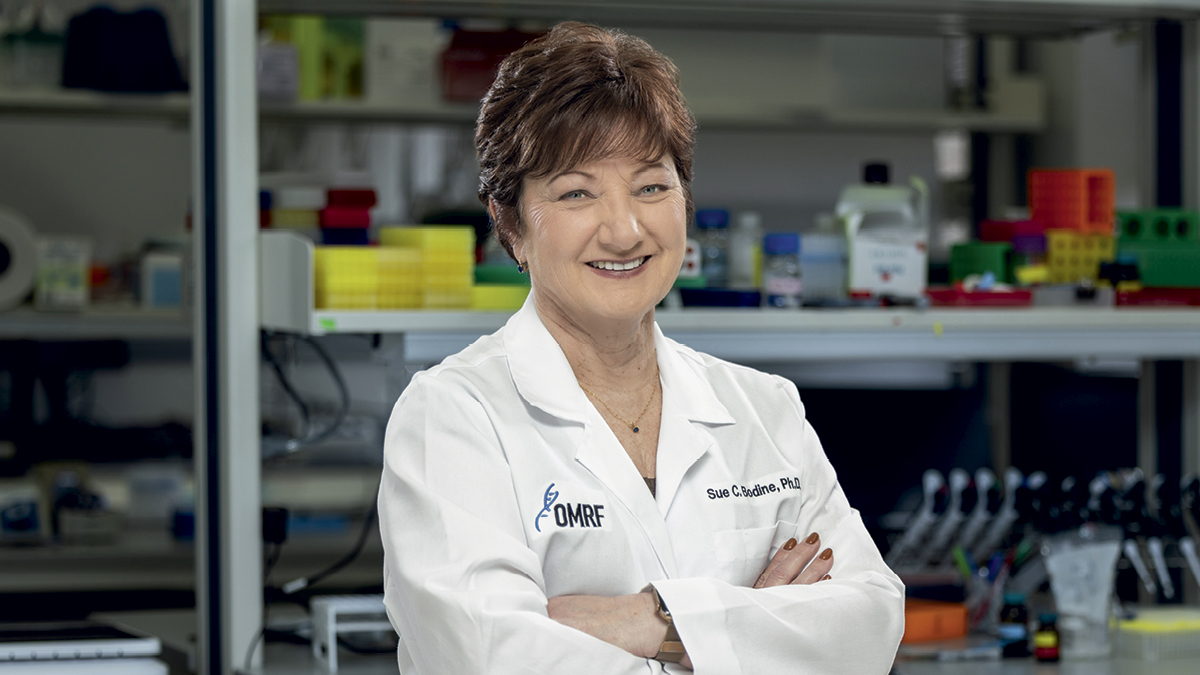
Sue Bodine, PhD, FAPS, was an undergraduate kinesiology major when she saw cadavers for the first time—limbs with the skin removed to reveal the structures underneath, muscles varying in size and shape. She was struck by how intricate everything was. “People sometimes visualize muscle as very simple, but it actually is a quite complex tissue,” she says.
Bodine, now in her fourth decade studying muscle, is the new APS president and professor in the Aging and Metabolism Research Program at the Oklahoma Medical Research Foundation (OMRF). “I have found muscles fascinating because they are so plastic,” she says. “They adapt; they respond to everything. Most tissues in the body try to maintain, don’t grow or atrophy constantly, but muscle has been designed to be responsive.”
As she has sought to understand how muscles adapt, Bodine has adapted too. She has worked in academia and the biotech industry, navigated challenging work settings, and continually learned new skills to support her research endeavors. Her CV is marked by major moves as she took up new opportunities. Everywhere she went, she learned something—from colleagues with different specialties and from experiments she worked on. The one constant has been her interest in muscle, the tissue that makes us move.
Finding Her Focus
When Bodine started her studies at the University of California, Los Angeles (UCLA) in 1976, the former high school athlete was interested in movement and the human body. She excelled in her courses and became fascinated by anatomy and physiology. Before long, her professors were asking if she’d like to help with research in their labs. She ended up participating in UCLA’s Departmental Scholar Program, which enabled students to pursue a bachelor’s and master’s simultaneously. Initially, she thought she would study biomechanics for her master’s, but her first research project with animal models and muscle contraction shifted her focus to physiology.
The project was looking at the role of muscle structure in muscle function. The researchers isolated an animal’s hamstring muscle, stimulated the nerve with electrodes, and recorded the contractile response. Bodine was responsible for filming the contractions and taking measurements related to muscular stress and strain. When she saw the muscle contract in real time, she got excited. “It wasn’t some abstract thing you were learning in class,” she says. “You’re actually seeing it with your eyes.”
The project ended up being her master’s thesis. It confirmed her interest in research and led her to pursue her PhD.
Throughout her studies, Bodine worked with Reggie Edgerton, PhD, an exercise physiologist and longtime UCLA professor. He was her thesis adviser and mentor and provided an example of how to let big questions guide her science.
“The thing that Reggie taught me more than anything is: You ask the question and then you find the techniques that you need to answer that question,” Bodine says. “Don’t be confined by what you don’t know.”
When Edgerton wanted to understand how the spinal cord controlled movement, Bodine says, he took a sabbatical and learned the techniques he needed to study the spinal cord. Working in his lab—first as a student and, after finishing her PhD in 1985, as a research scientist—required a similar openness to learning new methods.
In the 1980s, the U.S. was collaborating with the Soviet Union on a space program called Bion that sent animals to space in an unmanned capsule for two weeks at a time. Edgerton, who had done some research with NASA, wanted the Soviets to let American scientists take biopsies from their space monkeys and assess any changes from their time in space.
“He sent me to Moscow to convince them,” Bodine says. She learned how to take biopsies so she could demonstrate to the Soviets how the procedure would be done, and in 1988, she flew to Moscow on Pan Am with another researcher from NASA. Initially, Bodine’s first trip outside the U.S. didn’t go as planned. “They lost my luggage, so one of the scientists’ wives brought me a bunch of clothes,” she says. “I have this picture of me in front of the Kremlin in my Russian outfit.”
Despite the luggage mishap, the trip was a success. The Soviet space researchers agreed to the Americans’ proposal. Over nine years, Bodine was involved in three flights, traveling multiple times to Moscow to work with the animals.
Industry Comes Calling
Shortly after the Bion project kicked off, Bodine took a job at the University of California San Diego in the Department of Orthopedic Surgery. It was her first tenure-track job and her first time in a clinical setting. “It was very instructive in seeing the real-life concerns of physicians,” she says, “and seeing how your research could be applied to real medical problems.”
Through her conversations with hand surgeons, Bodine started wondering what happens when a peripheral nerve gets damaged and later needs to reattach to muscle. “The hand surgeons were often having to resuture nerves that were injured, and so people were looking at different ways of suturing the nerve ends back,” she says. She wondered: How do the nerve axons know which muscle to connect to? What happens if they connect to the wrong muscle?
She knew that the time needed to recover from orthopedic surgery could cause muscles to shrink from disuse and make it harder for nerves to reconnect. She was curious about how muscle could be kept in better shape while the nerve was regrowing.
In 1996, Regeneron called. The biotech company “had identified one of the receptors in muscle that was responsible for forming the neuromuscular junction,” Bodine says, “so they were interested in nerve regeneration and reinnervation.” They wanted to know if she’d join their team.
Bodine wasn’t sure. Though she was looking for a change, she hadn’t planned on leaving academia. But she saw that Regeneron was publishing in major scientific journals, and her research interests lined up nicely with their work. “It looked like a great place to do science,” she says. She interviewed and took the job.
Over her six years at Regeneron, Bodine dove into molecular biology for the first time. She ran a lab and became co-director of a research program. Free of teaching responsibilities or the need to write grants, she spent most of her time focused entirely on research.
“We were able to use the most advanced technologies,” she says. “Making genetically modified mice was just taking off, and Regeneron had developed new technologies, so I had access to all these genetic models. … It also taught me the value of teamwork, the idea of working in a team of people with different expertise to tackle a problem that any one person can’t do by themselves.”
Her team identified new genes involved in muscle atrophy and published major papers in Science and Nature Cell Biology, two of Bodine’s top-cited papers today. The findings went on to be replicated by other scientists and then translated to humans, laying the groundwork for the development of drugs to either slow muscle atrophy or support muscle recovery.
Embracing New Opportunities
In 2003, after a brief stint at another biotech startup, Bodine returned to academia at the University of California, Davis and set up her new lab with intentions to build on those genetic discoveries at Regeneron.
“I had identified these genes, and there were still lots of questions as to what they did,” she says. Regeneron sent her the mice they’d developed for her previous studies, and Bodine set to work looking at how the genes involved in muscle atrophy were turned on and what they were responsible for.
Several years into those explorations, Bodine attended a workshop about exercise hosted by the National Institutes of Health. Three of the institutes wanted to start a Common Fund program to better understand exercise’s health benefits. Bodine’s lab was one of three chosen for the initial preclinical research.
Starting in 2017, the project, called MOTRPAC (Molecular Transducers of Physical Activity Consortium), had labs across the country gathering and analyzing data from human and animal trials for a giant database that will eventually be publicly accessible. Bodine’s lab—which moved to the University of Iowa in 2017 and to OMRF in 2023—carried out animal trials, collecting and analyzing 19 tissues from different organs after acute and chronic exercise programs.
Through the project, Bodine observed that exercise’s effects extended beyond muscle to the kidneys, adrenals, colon, intestines, lungs and even different parts of the brain. “Every organ that we took out responded,” she says. They finished the trials in 2019; now, MOTRPAC is working on the analysis.
“It’s the era of big data,” Bodine says, and MOTRPAC has reams of it. “You have the whole lifespan, and looking at the effects of exercise training at different ages, and males and females, so it’s a tremendous resource.”
The project has been a sort of homecoming for Bodine, a return to her initial studies in exercise physiology and another way she’s adapted herself to opportunities in her field. Her adaptiveness has helped her make the most of her experiences. She’s been able to take what was useful—whether experimental techniques or a better understanding of an area of science—while leaving behind what wasn’t and may have actually been harmful, such as the all-too-common experience of gender bias.
“I have moved around a lot in my career, some by choice and some by necessity,” she says, “but I’ve always landed on my feet. And I pat myself on the back that I can overcome adversity.” That takes some muscle.
This article was originally published in the May 2026 issue of The Physiologist Magazine. Copyright © 2026 by the American Physiological Society. Send questions or comments to tphysmag@physiology.org.
6 Questions with Sue Bodine
In your role as APS president-elect and now president, you’ve been heavily involved in the Physiology: The Science Life Depends On campaign. What has that been like?
It’s been a really rewarding experience. One of the things that struck me is that physiologists are doing extraordinary work that shapes medicine, public health and everyday life, but the field itself isn’t always visible outside our community. This effort is about changing that. What I’ve appreciated most is that it helps connect physiology to the real-world outcomes people care about. It’s helping us articulate something we’ve always known: Physiology sits at the center of understanding how the body works and how we can improve human health.
Why is this work so important?
When the audiences we’re talking to hear directly from researchers about how physiology drives discoveries in areas like heart disease, kidney health or frailty, it becomes very clear how foundational this science is. For me personally, being involved has reinforced how important it is for our community to speak with confidence about the value of physiology. The science really does underpin so many advances people depend on every day, and this campaign helps us make that visible.
What has APS meant to you?
It’s been my scientific home. Because I’ve moved around a lot, it’s been the one constant. … I listen to some of the trainees now or even early-career scientists and they talk about their experience. It’s like a family. They get mentored. They have a network. People move around a lot in academia, and the Society is one place where we can all come together again.
What is your best career advice for someone considering leaving academia?
If you have the opportunity to move and you really like the place—if you think you might want to come back to academia, keep that option open. Stay engaged in your academic networks. Go to meetings. And the No. 1 thing is you need to publish if you think you might want to come back to academia.
What is something most people don’t know about you?
I am the oldest of seven, with five brothers. I am one of 99 Bodine grandchildren. My Grandmother Bodine was named National Mother of the Year (by American Mothers Inc.) in 1968.
What question should we have asked you?
What’s your favorite animal? Answer: golden retrievers. One of my goldens is a “Hero” and part of the Golden Retriever Lifetime Study.
The Physiologist Magazine
Read the Latest Issue
Don’t miss out on the latest topics in science and research.
Contact Us
For questions, comments or to share your story ideas, email us or call 301.634.7314.