

From Air Force Physiologist to Muscle Researcher
Marni Boppart has combined her love of flight and science to try to find a repair for muscle mass loss.
By Jenna Schnuer
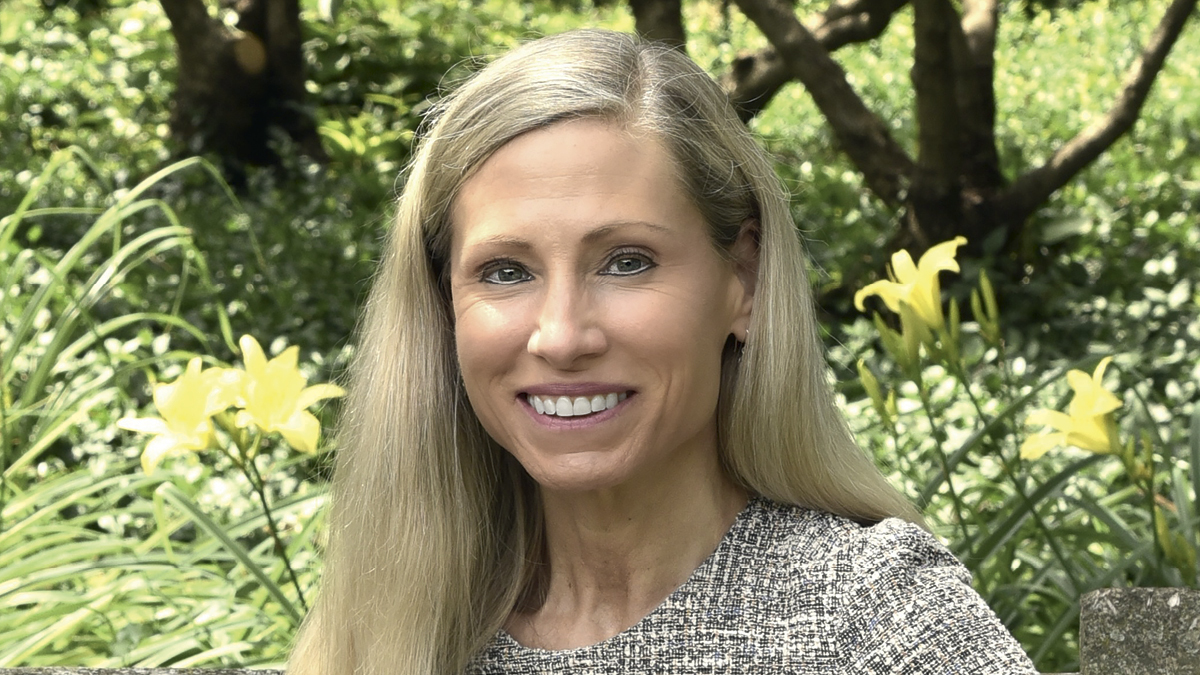
Ask Marni Boppart, ScD, FAPS, what connects an astronaut to a nursing home resident, and she has an answer: muscle.
Boppart sees a direct line between rehabilitation strategies that could help astronauts maintain their muscle mass while on long-term missions in microgravity environments and those that could help Earth-bound seniors live longer, healthier lives.
The work has been a long-term mission for Boppart, a professor in the Department of Health and Kinesiology at the University of Illinois, Urbana-Champaign (UIUC). She has spent the past three decades of her career studying skeletal muscle plasticity. Exercise has always been part of the mix too, both in the lab and personally.
Boppart’s father was a U.S. Air Force test pilot who was exposed to high levels of Agent Orange during the Vietnam War. He died from cancer when she was 14, leaving her wanting to learn more about his military experience. While an undergraduate biology major at the University of New Hampshire, she not only learned more about the human body, but also joined the Reserve Officers’ Training Corp, or ROTC. This combination of experiences was pivotal for her.
After graduating, Boppart joined the Air Force, where she became an aerospace physiologist. “My job was really fun,” Boppart says. Along with a team of military personnel and civilians, Boppart put her background in biology and physiology to work teaching aircrew members about the hazards of the high-altitude environment, including hypoxia, G-forces, spatial disorientation and visual illusions.
The job expanded to include work as the informal base exercise physiologist. She helped teach aircraft members about the importance of exercise and nutrition for human performance.
Boppart, an avid runner and hiker, has always been interested in the limits of human performance. “I have always wondered why humans have limits in terms of their ability to perform. Can we surpass those boundaries? And if so, what does it require?”
That curiosity began when Boppart was young. “Watching my dad fly his aircraft at the highest speed and breaking the sound barrier. And looking at astronauts in the microgravity environment and trying to understand can we really thrive in new environments? Those are the questions that have always fascinated me.”
The add-on role as the unofficial base exercise physiologist—which included getting up at 4:30 a.m. to work out with crew members—was a perfect fit. It was during those runs and lectures to the crew that Boppart’s fascination with muscle and studying exercise more in-depth was born. She gave up sleep in favor of adding a full-time master’s program in biology to her workload. The Air Force allowed her to take classes during the day and conduct research at night.
“It was a lot—and I’ll pay for it someday, I’m sure,” she says, laughing. “But once I finished with my master’s program and my four years of active-duty service, I knew I wanted to pursue research full time.”
Sharpening Her Focus
The question of human limits continued to drive Boppart. “I’m fascinated by the human body, and what we can withstand, and how we don’t collapse when we’re stressed. We adapt and we’re really resilient,” she says. “I wanted to understand the processes that allow us to perform better every time we exercise.”
Boppart moved to Boston to pursue a PhD in applied anatomy and physiology at Boston University (BU). “I wanted to dig in deep and understand the molecular changes that were happening inside muscle to allow for the maintenance or building of muscle,” she says.
While at BU, Boppart worked with two big names in the field of exercise science: Roger A. Fielding, PhD, also at BU (now at Tufts University), and Laurie Goodyear, PhD, at Harvard Medical School. Fielding was interested in the ways exercise and nutrition can improve healthspan in older adults, Boppart says, while Goodyear provided the molecular tools needed to study in-depth how exercise or nutrition was helpful for adults.
Working with Fielding and Goodyear propelled Boppart toward making a name in exercise science herself. As a collaborative group, they were one of the first to begin reporting exercise-driven molecular changes in human muscle.
After finishing her PhD program and her time in the Air Force, Boppart moved to Illinois with her husband, Stephen Boppart, MD, PhD. The couple met in the Air Force. Stephen is also a scientist at UIUC and one of Marni’s frequent collaborators.
At UIUC, Boppart’s interest in skeletal muscle grew. “It’s shocking how scientists have studied skeletal muscle for many years, but we still don’t fully understand all of the molecular events that allow for growth in response to exercise,” she says. “It’s the second largest organ in the body. It grows when we work out. It atrophies when we don’t. What is regulating those processes? This is why I still love my work. I’m so interested in trying to understand those unknowns.”
For the past several years, Boppart’s research has been focused on developing a novel therapy that could drastically improve life on Earth (and beyond) for a lot of people.
NASA’s Artemis project, a moon exploration project aimed at building a permanent lunar base, could create a sustained presence on the moon and even allow for missions to Mars. While exciting for the future of space exploration and discovery, space has detrimental effects on the human body and health. “The long-term implications for astronauts is devastating,” she says.
When humans lose muscle mass, it’s incredibly hard to regrow it. “We need to not just preserve muscle mass in space but also aid in the recovery process afterwards.”
Older adults also lose significant muscle mass during periods of bedrest and hospitalization, losses that are never fully recovered. Currently, no effective treatments exist to rebuild muscle, whether the loss is from spaceflight or aging.
To address these challenges, Boppart has been working on developing a synthetic biologic shot that could mimic the effect of exercise on muscle growth. The current approach includes extracellular vesicles (EVs) derived from blood collected after exercise.
EVs are nano-sized particles secreted from cells that possess important molecular cargo, including beneficial proteins that are synthesized during exercise. “While other researchers were already extracting EVs from blood after exercise and measuring their concentration and content, they hadn’t fully tested their function in depth,” Boppart says.
She and her colleagues decided it was time to take a closer look. They collected samples from young, healthy men and women engaged in a six-week combined and progressive endurance and strength training program, as well as from mice after four weeks of wheel running. What they found was that the blood EVs, which were enriched with antioxidants and chaperone proteins, could recover skeletal muscle fiber size and/or capillary content when injected into mice after a period of disuse.
Having just recently published their first two studies, they’re currently focused on testing which “exercise modality and intensity produces the most beneficial EVs, as well as sex differences in EV functionality.”
Boppart’s hope is that over time, they’ll be able to develop a synthetic version of the EVs that could, initially, help frail older adults in need of rehabilitation after a long period of bedrest.
They also need to pinpoint the precise molecular cargo driving the beneficial changes. “Then we can simply create our own nanoparticles by packaging those ingredients. However, we do realize it’s not just one single molecule that’s driving these changes; it’s a combination,” she says.
Of course, there are no fast answers in research. It could take another decade or longer to develop the product. But Boppart isn’t put off by the timeline. “There is amazing fulfillment in developing a product that might be able to help our society,” she says. “I finally feel like we’re at that place where, fingers crossed, maybe this will work. This is what sustains me now.”
This article was originally published in the September 2026 issue of The Physiologist Magazine. Copyright © 2026 by the American Physiological Society. Send questions or comments to tphysmag@physiology.org.
5 Questions with Marni Boppart
What’s your best piece of career advice?
Say “yes” to opportunities that scare you. New challenges, positions or tasks are always daunting and set us up for making mistakes. However, we can’t grow and improve, either personally or professionally, if we don’t take risks. Be adventurous, take the risk. You won’t regret it.
How do you de-stress?
Exercise, of course! My family and students know that I need to run in the morning and take walks in the afternoon. It helps me to decompress. It also gives me time to think outside the box and be creative.
What was the coolest thing you did in the U.S. Air Force?
My time in the U.S. Air Force was full of adventures. Training our aircrew members about the physiological hazards of the high-altitude environment meant exposing myself to hypoxia in the altitude chambers, G-forces in the human centrifuge and freefall parachuting. I also took flying lessons, traveled with our crews and taught parasailing. It was a wild ride!
Where’s your favorite place to get away from it all?
A warm sunny beach or a mountain cabin anywhere sounds great! But I really enjoy the peace and quiet of my backyard, where we have a pool and a lake. My husband and I joke that there’s no reason to go on vacation anymore.
What’s something about you most people don’t know?
I am allergic to chocolate! I won’t die if I eat it, but it makes me itch. I love anything vanilla flavored.
The Physiologist Magazine
Read the Latest Issue
Don’t miss out on the latest topics in science and research.

Contact Us
For questions, comments or to share your story ideas, email us or call 301.634.7314.