

Advice for Science Trainees in Uncertain Times
Physiologists share mentorship advice on communication, resilience and career paths shaped by real experience during periods of challenge and change.
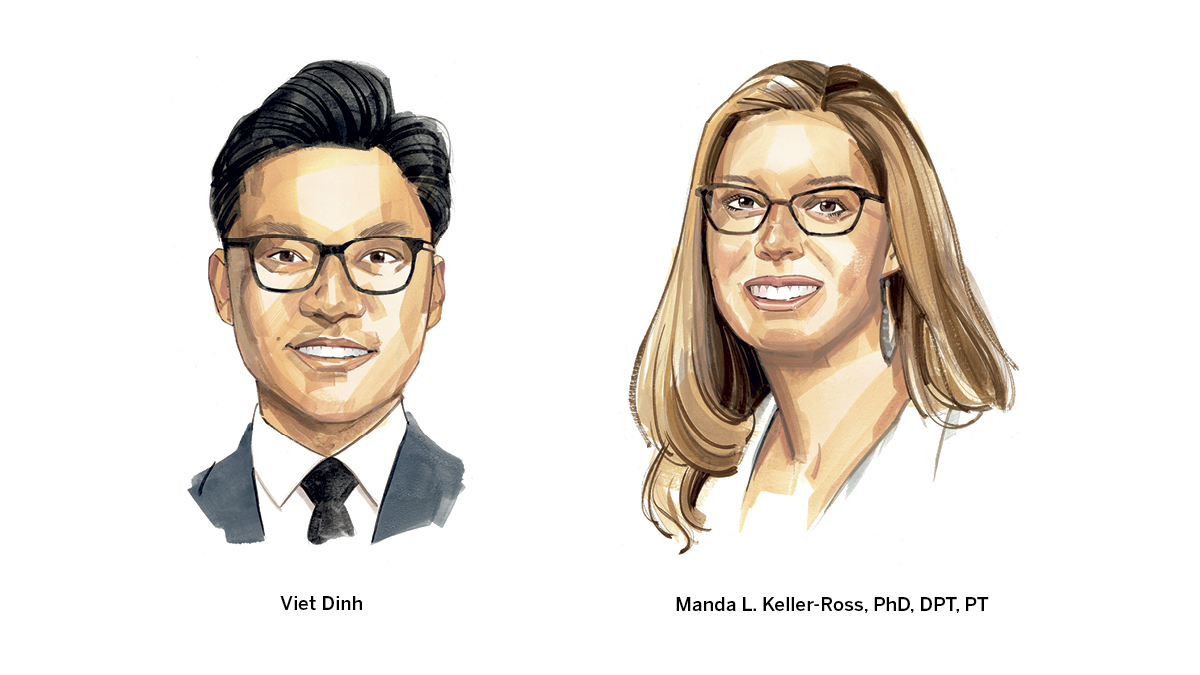
Viet Dinh, a PhD candidate in integrative physiology at University of North Texas Health Fort Worth, asks Manda L. Keller-Ross, PhD, DPT, PT, about how to handle uncertain times as a trainee. Keller-Ross is an associate professor in the Division of Physical Therapy and Rehabilitation Science within the Department of Family Medicine and Community Health at the University of Minnesota Medical School.
Q: There has been discussion among scientists about our need to improve scientific communication with the public. How can we do that?
A: Our lab has been working on this for three to four years. There are things we can do, like hold events at local health fairs and festivals, where you set up a booth to talk about your research with the community. Also, it is important to have an “elevator pitch” to convey your research—how you might explain your work to your friend who has no scientific background in two minutes or less.
If you do human research, another thing you can do is share your findings with the research participants. Write an easy-to-understand summary of your research and attach it to the publication with a thank-you note.
Q: We have all been living under this period of uncertainty when it comes to the scientific community and the government. Do you have any advice on how scientists, particularly trainees, can combat these uncertainties?
A: It is a challenging time for all. The No. 1 thing to incorporate during these times is joy, whether that is driving your research harder, taking more time to exercise, spending more time with family or friends, or engaging in a new hobby. We have to keep ourselves moving and engaged.
This is also a time when we can become creative within our own research. My current focus is on women’s health, and these uncertain times are forcing me to consider alternative approaches to answer my research questions. Be as open and flexible as you can to different opportunities. This may involve meeting and speaking with scientists at conferences, visiting conference vendors to discuss careers in non-academic spaces, and opening new conversations with your mentor(s).
Q: What advice do you have for a trainee seeking a non-academic career path?
A: Industry or science policy are excellent career paths. We need strong scientists in these spaces. Regardless of the path, I would give three pieces of advice: Talk with people in those spaces to get different perspectives on what it is like to work in those environments. Be sure the career choice is in line with your values and passion and what you envision for your future self. And remember that nothing is ever permanent; if the position does not suit you for whatever reason (academic or non-academic), it is up to you to create the change.
Q: What drives you?
A: What initially drove me into my PhD was the scientific inquiry. I enjoyed asking questions and then designing a study to answer those questions. Now, it is serving the needs of the community. I talk to many women who are not receiving menopause education from their health care providers. I enjoy conducting research in aging women’s health, partly because there are so many unanswered questions, but also because women suffer with increased prevalence of chronic disease after menopause. Once we understand the mechanisms contributing to these diseases and the role of menopause versus age, we can develop more promising preventive treatment, as well as therapeutics, to improve the health and well-being of women.
Got a career question you'd like to submit? Email it to tphysmag@physiology.org. We may use it in an upcoming Mentoring Q&A.
This article was originally published in the January 2026 issue of The Physiologist Magazine. Copyright © 2026 by the American Physiological Society.
“It is a challenging time for all. The No. 1 thing to incorporate during these times is joy.”
The Physiologist Magazine
Read the Latest Issue
Don’t miss out on the latest topics in science and research.
Contact Us
For questions, comments or to share your story ideas, email us or call 301.634.7314.