

Building a Scientific Legacy
How to pursue meaningful projects and motivate students.
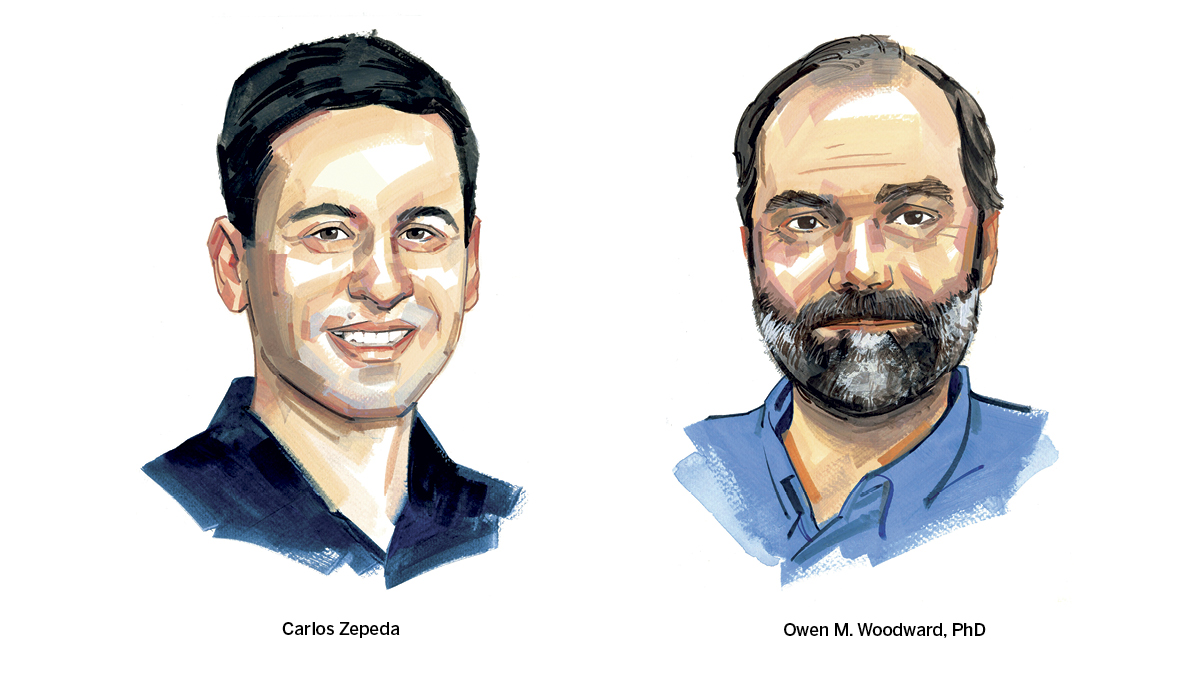
Carlos Zepeda, a PhD candidate at Marquette University, asks Owen M. Woodward, PhD, how to decide what research questions to focus on. Woodward is an associate professor in the Department of Physiology and Department of Medicine at the University of Maryland.
Q: What factors do you consider when deciding whether a research question is worth investing time and resources in?
A: I consider four factors. The first, and most important, is simply: Is it interesting, am I excited by thinking about it, will it get me up in the morning? Then, I ask: If we do make progress on this new research question, will it lead to a new understanding in the field or new therapeutic approach in the clinic?
The third factor is whether the lab has the expertise or tools necessary to really make progress on this new question. This is a practical consideration, and technical roadblocks can often be overcome, but the more expertise you need to build, the more time and money is necessary.
The fourth factor that needs consideration is: How easy will it be to get funding? It is unfortunate that this must be one of the factors we think about, but funding is always a part of the decision process.
Q: How do you motivate and support students when they experience setbacks?
A: The first thing I always tell students is that the vast majority of things you do in the lab (or life) will not go as anticipated. Experiments will fail for a million reasons: bad experimental design, incorrect hypotheses, expired reagents. This is just part of the process of becoming an experimental scientist. As much as we try, we cannot control for everything. Success is built on perseverance more than inspiration.
On the flip side, when a result or an experiment goes well, I reinforce how amazing that is. They have just accomplished something no one else has ever done or discovered something no one else ever knew! This realization goes a long way in ameliorating any frustrations.
Q: What have been your biggest challenges as you transitioned to being a principal investigator (PI)?
A: I love doing experiments. The satisfaction of seeing a result in real time is hard to replace. But leading a lab is so much more rewarding and intellectually stimulating. Instead of focusing on the minutiae of individual projects you get to synthesize all the data coming from all the people in your lab and make meaningful conclusions about your science and your field. You also benefit from working with students and postdocs and sharing their infectious enthusiasm for science.
The challenges come from the other aspects of being a PI. The way that the biomedical research enterprise is built requires PIs to find money to support everyone in the lab and their work. Aspects of the process are creative and exciting, but the continuous exercise of grant writing becomes burdensome. It’s a difficult trade-off, but for me, worth the price to keep doing science.
Q: What do you hope your lab’s long-term legacy will be on the field?
A: I hope the work we do in our laboratory will help people. This might be in the form of a new understanding of human health that changes the way patients are treated in the clinic. This might be a new understanding of a mechanism or a process that was unknown previously. Because some of the work we do is basic, I also hope it unveils a little bit about how life works on Earth, fundamental truths about our existence, even if it has nothing to do with a new pharmaceutical product. Equally, I hope a lasting impact of the lab is in training excellent people who go on and do cool and amazing things.
Got a career question you'd like to submit? Email it to tphysmag@physiology.org.
This article was originally published in the September 2026 issue of The Physiologist Magazine. Copyright © 2026 by the American Physiological Society.
The Physiologist Magazine
Read the Latest Issue
Don’t miss out on the latest topics in science and research.

Contact Us
For questions, comments or to share your story ideas, email us or call 301.634.7314.