

How to Build a Successful Academic Career in Physiology
An established physiology researcher shares advice on AI tools, lab culture, funding reform and what it takes to build a modern academic career.
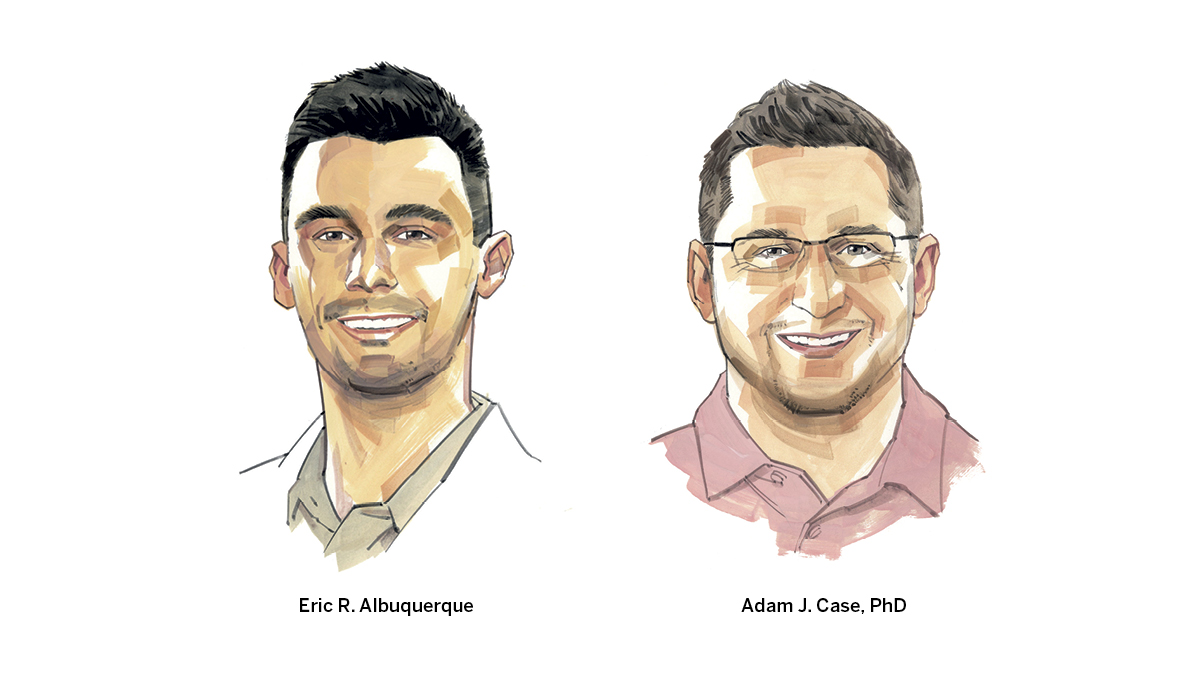
Each issue, we ask a student or early-career member to pose their career questions to an established investigator and mentor. Here, Eric R. Albuquerque, an MD/PhD candidate at the University of Miami Miller School of Medicine, asks Adam J. Case, PhD, several future-focused questions. Case is associate department head for basic research and an associate professor in the Department of Psychiatry and Behavioral Sciences and Department of Medical Physiology at the Texas A&M University Naresh K. Vashisht College of Medicine.
Q: Artificial intelligence (AI) applications and models are extremely powerful tools that can have real benefit, but also pitfalls. How should trainees use these tools?
A: We have all experienced ways in which AI is incredibly impressive, but also how it can be unhelpful, frankly terrible, or outright wrong. Even with these experiences, it is likely that AI will become more prevalent in our lives, both personally and professionally. In research, staying on top of technology is essential to remain competitive. I recommend trainees embrace AI workshops, training courses or other opportunities to become proficient (at least comfortable) with the technology. At a minimum, these skills may allow you to save time on tasks and accelerate your research, but they may also allow you to create a tool or opportunity in your own niche that could launch your research program into a new direction.
Q: When transitioning into a new faculty position, what strategic areas should new researchers capitalize on to ensure their lab’s successful launch and sustainable growth?
A: Every early-career investigator’s situation is going to look different depending on factors such as funding already received, how much data they have already collected from a previous position, or whether their new position is at a new location.
That said, one of the first critical steps for a new investigator is growth, which in research usually means people and equipment. As a faculty member, your time will be stretched thin with many commitments, so personnel are essential to research productivity and growing your program. Regarding equipment, consider what is a “need” versus a “want” and what you will use on a routine basis. Big equipment can be expensive to maintain and service, so if using it at a core facility or third-party vendor can suffice, it sometimes is better than investing your precious start-up dollars.
Q: What self-imposed expectations helped you establish and sustain your career?
A: The biggest expectation I put on myself was never forgetting that I am in academia to train scientists—not just publish papers or get grants. Some may think that hinders productivity, but by developing and supporting my trainees, I have found they put in as much or more effort into the work.
Trainees enjoy my lab environment because they see me putting my all into their career development, which makes the job enjoyable. In contrast, the expectation that I could handle everything became unsustainable, and I am still learning this lesson today. Strategic focus on your strengths leads to excellence. Maximal output across everything leads to burnout.
Q: Fewer graduates seem to be choosing academia compared to industry or government. What needs to change to make academia more appealing?
A. Funding reform. Full stop. While “more funding” would also be appealing, I have more discussions with my colleagues about factors that need reformed, such as how funding is distributed, funding restrictions, peer review and funding decisions, salary coverage requirements from funding, and indirect funding to universities.
These factors often come across as daunting to trainees, and when they see PhD-level careers that do not require traversing the nebulous funding landscape, the perception is those careers are more stable and safer (whether accurate or not).
Got a career question you'd like to submit? Email it to tphysmag@physiology.org. We may use it in an upcoming Mentoring Q&A.
This article was originally published in the May 2026 issue of The Physiologist Magazine. Copyright © 2026 by the American Physiological Society.
The Physiologist Magazine
Read the Latest Issue
Don’t miss out on the latest topics in science and research.
Contact Us
For questions, comments or to share your story ideas, email us or call 301.634.7314.