

From Physics to Physiology: A Scientist's Unconventional Journey
Meet Natalya Zinkevich, PhD, who found her passion in research, teaching and student mentorship.
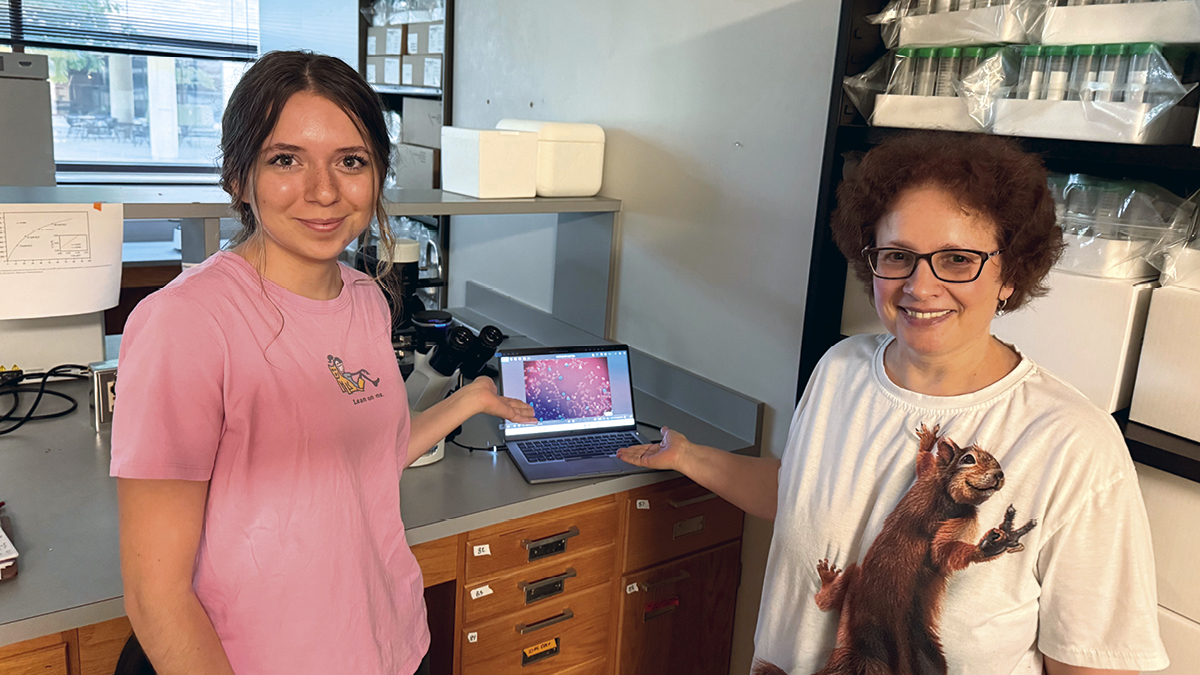
Natalya S. Zinkevich, PhD, is an assistant professor at the University of Illinois Springfield. She teaches undergraduate introductory and upper-level human anatomy and physiology, human disease, and comparative vertebrate biology courses. She is passionate about conducting research with students interested in vascular physiology.
A SCIENCE CITY. I grew up in the Russian science city of Dubna in the Moscow region and was surrounded by scientists. My mom and dad worked for the Joint Institute of Nuclear Research, an international research center for nuclear sciences. Math and physics were greatly emphasized in the school I went to. It is not surprising that many of my classmates decided to become physicists to follow in the footsteps of their parents. My rebellion was to become a biologist. As a young child, I read “My Family and Other Animals” by Gerald Durrell and became greatly interested in zoology. Later, I learned about the tragic fate (persecution, imprisonment and execution) of geneticists during the Soviet Union, which inspired me to seek a degree in biology/genetics.
NOBEL INSPIRATION. I would like to meet Christian Nüsslein-Volhard, PhD, who was awarded the Nobel Prize in Physiology or Medicine in 1995. As a graduate student, I was inspired by her groundbreaking research on drosophila homeobox genes and even wrote her a letter. I consider myself lucky to have had a chance to use Nüsslein-Volhard’s favorite animal models—fruit flies and zebrafish—for genetic experimentation. I have great admiration for her long and productive career in research and her incredible efforts to promote science literacy and support gender equality in science.
THAT “AHA!” MOMENT. The favorite part of my work are moments with students when you keep re-explaining difficult concepts and all of a sudden their eyes light up. Or when a student asks a very thoughtful question, demonstrating a deep interest in the concept. Other moments I really cherish involve doing research with students, as I can see them formulating the research hypothesis and testing it in the lab.
PHYSIOLOGY IS FOUNDATIONAL. It impacts everything from medical breakthroughs to our understanding of life across all organisms. I love helping people understand that and making physiological research more accessible and relatable. That’s why I contribute to the I Spy Physiology Blog, and I encourage my students to do the same. The blog connects real-world applications of physiology to everyday life.
WIDE WORLD OF SCIENCE. Physiology also extends beyond human biology. Previously, I taught organismal physiology, the study of the physiology of plants and animals. Microbial physiology is another intriguing field. I see the value in exploring how physiological processes operate across species.
Do you know someone we should meet? Email us at tphysmag@physiology.org.
This article was originally published in the November 2025 issue of The Physiologist Magazine. Copyright © 2025 by the American Physiological Society.
The Physiologist Magazine
Read the Latest Issue
Don’t miss out on the latest topics in science and research.
Contact Us
For questions, comments or to share your story ideas, email us or call 301.634.7314.