

Finding Meaning in Exercise Physiology and Healthy Aging
An exercise physiologist reflects on his career and how studying exercise helps advance healthy aging and public health.
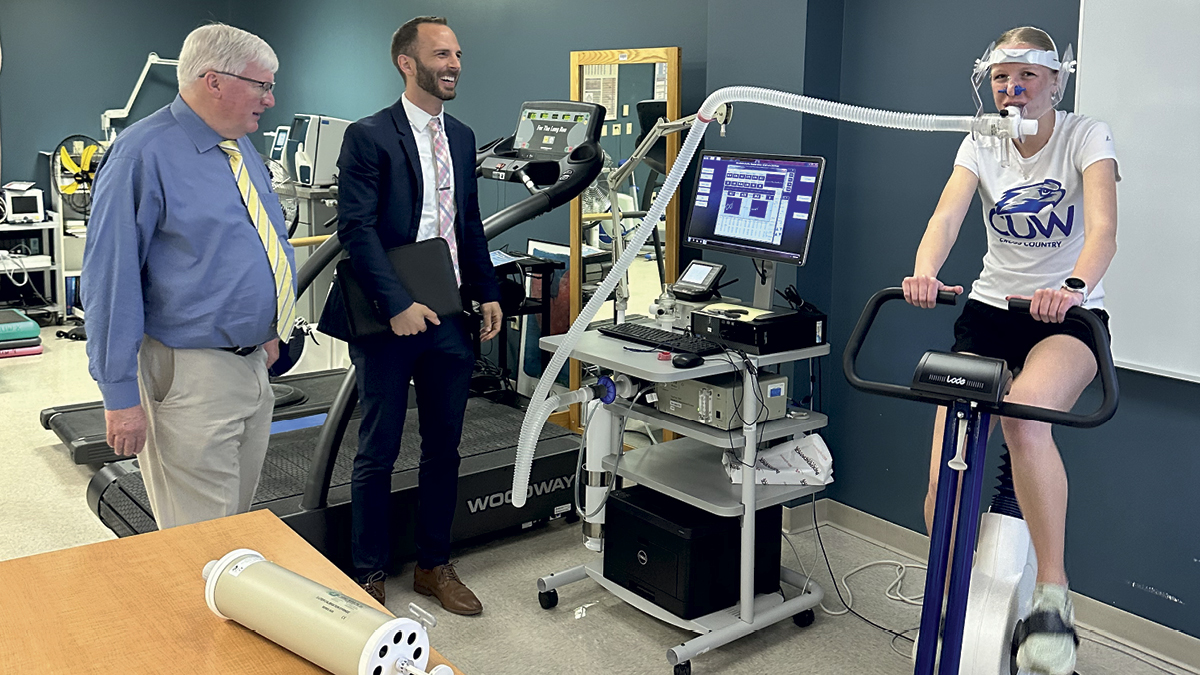
Kevin Gries, PhD, is an assistant professor of physical therapy at Concordia University of Wisconsin. His research interests focus on understanding how best to use exercise as medicine, particularly to combat sarcopenia and metabolic diseases.
FASTER RUNNING, HEALTHY AGING. I wanted to learn how I could become a better runner. In high school, I read papers and used various ergogenic aids and training plans to become faster. This continued in college as an exercise physiology major. When I realized I eventually needed a job to pay the bills, I finally got serious about my career. I participated and assisted in as many studies as I could and decided I wanted to be a scientist. It’s really cool how hard people have to work by exercising just to turn on and off genes to make these tiny organelles called mitochondria that have such an impact on health and performance. As I study the exercise response now, my focus is more on aging. As I—and the general population—get older, my work helps public health and achieves my personal goals for learning how I can age healthier.
FALL BREAK MISTAKE. During a fall break early in my PhD training, very few people were in the lab. I was practicing tying single muscle fibers under the microscope. I really struggled learning this skill. I finally did this successfully when Dave Costill, PhD—a giant in exercise physiology—walked in. I was so excited to tell him I did it. He suggested I take the muscle fiber off and do it again. I tried again, but I broke the motor arm off the equipment. My adviser later showed me the bill to fix the equipment and told me (lovingly) that it was an expensive learning opportunity. It was here that I learned to not let your highs get too high or lows get too low.
MEETING A LEGEND. I would want to meet August Krogh. He was instrumental in our understanding of oxygen diffusion and won the Nobel Prize in Physiology or Medicine in 1922. He was extremely influential in developing equipment and fields within physiology (exercise physiology and experimental physiology). From a personal perspective, I think it is interesting how closely he worked with his wife, Marie. Additionally, he published papers referred to as the “7 Little Devils” refuting his PhD adviser, Christian Bohr. It would be interesting to hear how Krogh politically managed that situation.
CREATIVE PUZZLE-SOLVING. Brainstorming with other faculty and students on dream projects is my favorite part of my job. I love sitting down with a bunch of data that originally doesn’t make sense and then making sense of it. Both tasks allow you to be creative and learn from others’ perspectives to put together the puzzle pieces to make sense of a problem.
A BROAD FIELD. One of the misconceptions of physiology is that thinking that because we know a lot about one area means we know a lot about another area. Physiology is an extremely broad term. How each organ interacts with another is very complex. It is just not possible to know everything about physiology. Therefore, if we do not know the answer to something, it doesn’t mean our entire education or advice is invalid. Physiology is just too complex for one person to know everything.
Do you know someone we should meet? Email us at tphysmag@physiology.org.
This article was originally published in the January 2026 issue of The Physiologist Magazine. Copyright © 2026 by the American Physiological Society.
“As I—and the general population—get older, my work helps public health and achieves my personal goals for learning how I can age healthier.”
The Physiologist Magazine
Read the Latest Issue
Don’t miss out on the latest topics in science and research.
Contact Us
For questions, comments or to share your story ideas, email us or call 301.634.7314.