

From Classroom Curiosity to Scientific Discovery
A graduate researcher shares how early inspiration shaped her path in physiology and why innovation keeps the field dynamic.
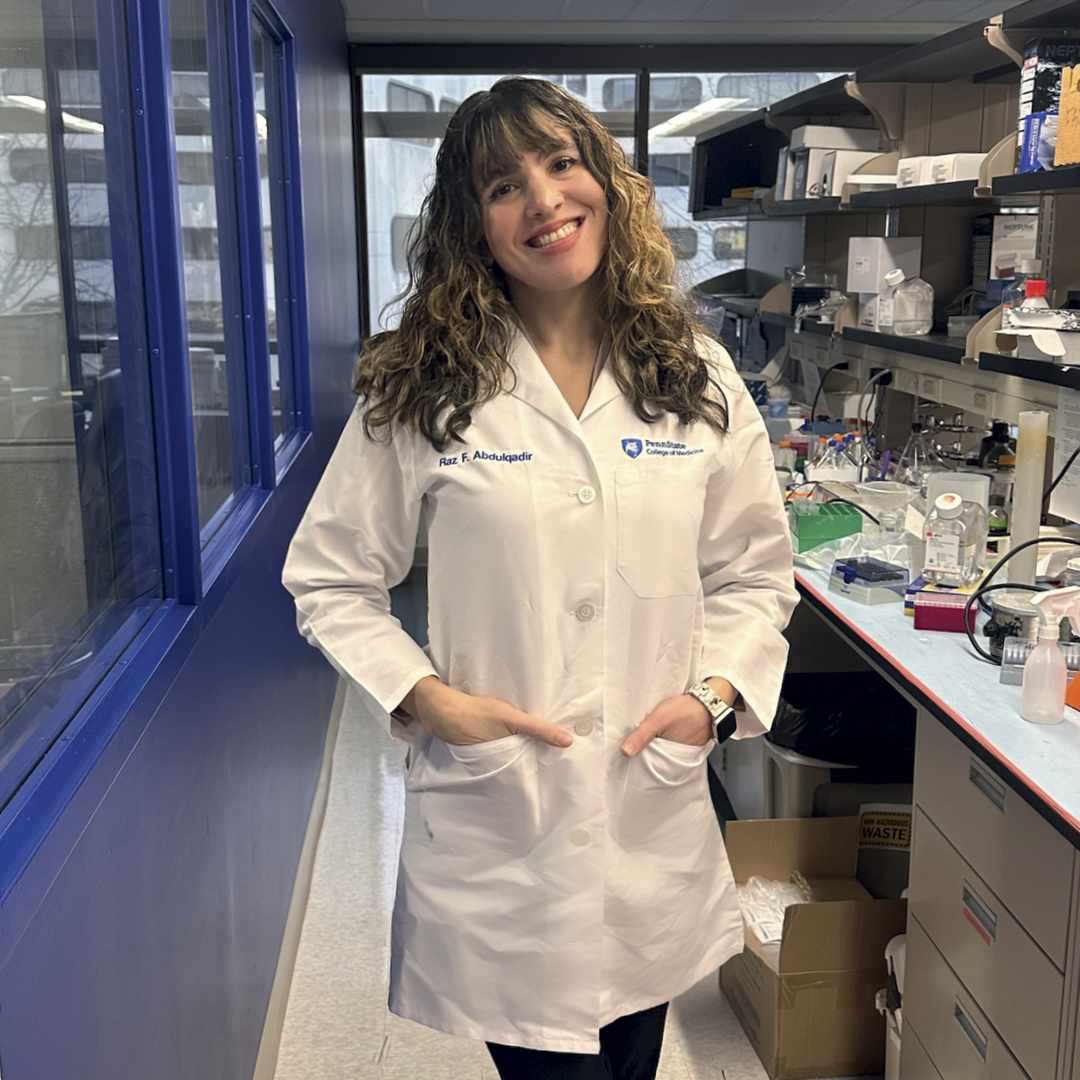
Raz Abdulqadir, PhD, is a graduate assistant in the biomedical program at Penn State College of Medicine. Her research specializes in intestinal epithelial barrier function and probiotic-host interactions. She is passionate about mentoring the next generation of scientists and advancing effective science communication.
A classroom spark. I’ve always been naturally curious about the world around me. As a child, I often found myself daydreaming in class. I didn’t do well academically at first, but my curiosity never faded. My first real spark of interest came during a middle school science lesson when my teacher explained molecules and atoms and how they collide. It felt like unlocking a hidden universe. I often tell my son—and I want other children to know—that just because you don’t like school right now, or you’re struggling, doesn’t mean you’ll fail academically. Once you find your passion, or meet that one teacher who inspires you, everything can change.
Changing lives. What motivates me most is knowing that the discoveries we make in the lab can one day save lives. That possibility inspires me to be part of a world where I can constantly learn new things while making a meaningful impact—a world where curiosity leads to breakthroughs that truly matter.
Western blot blooper. Like many scientists, I’ve had my share of Western blot mistakes. I was using a fluorescent dye to label bacterial DNA green so I could study its interaction with host cells. I carefully followed the protocol, fixed the cells and prepared them for imaging. But when I looked under the microscope, everything was glowing green—the bacteria, the intestinal cells, even the background! The dye was so strong that I couldn’t see any details, just an overwhelming green blur.
First woman of science. One pioneer I would love to meet is Madame Marie Curie. I would love to learn about how she made her groundbreaking discoveries in radioactivity, how she navigated the challenges of being the first woman in a demanding and male-dominated field, and how she balanced her scientific career with motherhood. Her achievements not only transformed our understanding of physics and chemistry but also paved the way for generations of women in science.
Love of learning. My favorite part of my job is the constant learning and discovery. I love trying to understand the complexity within science, looking at new data and feeling that curiosity that makes me say, “Wow, this is so interesting.”
Beyond the traditional. Physiology has evolved far beyond traditional boundaries, incorporating cutting-edge technologies such as multi-omics integration, advanced imaging, organ-on-chip models, confocal microscopy, artificial intelligence-driven analytics and translational therapeutics to uncover complex mechanisms. Physiology is not static; it’s a constantly evolving discipline that adapts with innovation, making it one of the most exciting and interdisciplinary areas of science.
Do you know someone we should meet? Email us at tphysmag@physiology.org.
This article was originally published in the March 2026 issue of The Physiologist Magazine. Copyright © 2026 by the American Physiological Society.
“What motivates me most is knowing that the discoveries we make in the lab can one day save lives.”
The Physiologist Magazine
Read the Latest Issue
Don’t miss out on the latest topics in science and research.
Contact Us
For questions, comments or to share your story ideas, email us or call 301.634.7314.