

- Membership & Community
-
Publications & News
- Physiology Journals
-
Newsroom
-
The Physiologist Magazine
- 2019
- 2020
- 2021
- 2022
- 2023
- 2024
-
In Depth
- In Depth—The Bear Necessities
- In Depth: Understanding Circadian Rhythms
- In Depth: Understanding Data
- In Depth: Exercise Physiology: Take Your Medicine at the Gym
- In Depth: Neurodegenerative Disorders
- Imaging Methods Unveil the Invisible
- Rewiring the Brain: Breakthroughs in Neural Therapy
- What’s Coming Next for GLP-1 and Metabolic Disease Treatment
- Understanding the Effects of Maternal Exercise
- How Muscles May Hold Cues to Better Sleep
- The Science Behind Breathwork and Mental Health
- How Science is Reframing Aging and Disease
- How Exercise Supports Brain Health Across the Lifespan
- What Snake Physiology Reveals About Gut Healing and Diabetes
- Mapping Multiple Diseases with One Imaging Tool
- How Brain-Lung Connections Could Change Disease Treatment
-
Mentoring Forum
- Net Worth
- Take Care
- You … In Charge
- Work. It. Out.
- Working Off-site
- Location, Location, Location?
- Student Support
- Progressing to Postdoc
- Relationship Building
- Let’s Get It Started
- What Do We Value?
- It’s a Postdoc Life
- Coronavirus Contributions
- Creative Communications
- Selection Process
- Conference Connections
- Postdoc Appreciation
- Research Rewards
- Focus on Teaching
- Industry Insights
- Balance Beam
- Post Postdoc
- If You Build It
- Talk It Through
- Forward Bound
- I’ve Earned My PhD. Now What?
- University Life
- Tips for Trainees
- Time Travel
- Prepare Now for the Career You Want
- Landing a Postdoctoral Researcher Position
- Becoming a Physician-Scientist
- Mastering the Art of Science Communication
- Setting Yourself Up for Success in the Lab
- From Postdoc to Professor: Key Strategies for Success
- How to Stay Motivated in Challenging Times
- Staying Motivated Throughout Your Science Career
- Managing Stress and Workload During Your PhD
- Stay Passionate About Your Physiology Career
- Advice for Science Trainees in Uncertain Times
- What Career Success Looks Like for Scientists Today
- How to Build a Successful Academic Career in Physiology
- A Mentor's Truths About Building a Career in Science
- How to Choose Meaningful Research Questions
-
Policy IQ
- Policy IQ—2023 in Review: How APS Advocated on Behalf of Physiologists
- Policy IQ—Supporting Equitable Research
- NIH's Road Map to a Better Postdoc Experience
- The Career Path to Science Advocacy
- Culture of Safety: Stopping Sexual Misconduct
- Physiologists Return to Capitol Hill
- Tips for Scientists to Communicate about Animal Research
- Science Advocacy in a New Political Landscape
- Tips for Making the Call to Congress
- Science Spending Is an Investment
- Advocacy Up Close and Personal
- How Animal Research Advances Physiology and Medicine
- 5 Ways Physiologists Advocated for Science in a Challenging Year
- How Federal Grantmaking Is Reshaping Research Funding
- Federal Science Funding: Where Things Stand and What Comes Next
- How Physiologists Can Shape NIH Funding and Policy
- What Researchers Need to Know About Indirect Costs
-
Publish with Polish
- Publish with Polish
- The Layers of Open Science
- Take Your Content From Meeting to Manuscript
- APS Journals to Highlight Women’s Health Research
- What Subscribe to Open Means for APS Members
- The 5 Pillars of Publish with Purpose
- 3 Types of Metadata Researchers Should Know About
- Navigating Open Access and New Licensing Options
- Journal Manuscript Prep Made Easy
- How to Navigate Public Access Requirements
- Ensuring Public Trust in Publishing
- Improve Your Scientific Figures With APS and BioRender
- How APS Subscribe to Open Supports Accessible Research
- Meet APS Publications at the Summit
- How APS Is Making Physiology Research Open Access
- What Authors Need to Know About APS' New Submission System
- Credit Where It’s Due
-
Under the Microscope
- Equine Inspiration
- Inquiring Minds
- The Power of Teaching
- The Love of Physiology
- Understanding Women's Physiology Across the Lifespan
- Studying Human Health in Extreme Environments
- Advancing Kidney Health and Physiology Research
- How Gut Microbes Shape Blood Pressure and Drug Response
- Battling Malaria
- Exploring the Microbiome
- From Physics to Physiology: A Scientist's Unconventional Journey
- Finding Meaning in Exercise Physiology and Healthy Aging
- From Classroom Curiosity to Scientific Discovery
- From Cycling to the Lab: How One Physiologist Found His Mission
- This Neuroscientist Wants Everyone to Understand Science
- Kidney Health, Research and Discovery
- Mentoring Q&A
- Evolution
- 2025
- 2026
- Find Us on Social Media
-
The Physiologist Magazine
-
Professional Development
-
Meetings & Events
-
American Physiology Summit
- Abstracts
- Awards at the Summit
- Award Lectures
- Dates and Deadlines
- Hotel Information
- International Travel Information for Summit Attendees
- American Physiology Summit PhysioHub
- Summit FAQs
- Travel & Transportation
- Industry Partners
- Scientific Integrity Policy
- Exhibitor Registration Form
- 2027 American Physiology Summit Keynote Speakers
- Control of Renal Function in Health and Disease
- Comparative Physiology Conference
- Signals and Systems: Interorgan Communication in Health and Disease Conference
- Integrative Physiology of Exercise Conference
- Webinars
- Future APS Conferences
- Conference Policies
-
American Physiology Summit
- APS Awards
-
Career & Professional Development
-
Career Gateway
-
Resources
- Transcript—Leading Through Conflict and Difficult Conversations
- Transcript—Managing Conflict with Colleagues
- Transcript—Leading a Team Through Conflict
- Transcript—Providing Difficult Feedback
- Transcript—Team Dynamics and Culture Primer
- Transcript—Building a Team
- Transcript—Leading a Team Assigned to You
- Transcript—Creating a Team Culture
-
Resources
- Careers in Physiology
- Center for Physiology Education
- Virtual Courses
- From Academia to Industry: Prepare for Careers in Biotech and Pharma
- Physiology Job Board
- APS Graduate Physiology & Biomedical Science Catalog
-
Career Gateway
-
Meetings & Events
-
Advocacy & Resources
- Science Policy
-
Resources
- Researcher Resources
- Educator Resources
- Trainee Resources
- Student Resources
-
APS Graduate Physiology & Biomedical Science Catalog
- Des Moines University
- George Washington University
- New York Medical College
- Pennsylvania State University
- Texas A&M University
- Texas A&M University Medical Physiology
- University of Alabama at Birmingham
- University at Buffalo
- University of Colorado
- University of Michigan
- University of Minnesota
- University of Missouri-Pathobiology and Integrative Biomedical Sciences
- University of Nebraska Medical Center
- University of Nevada, Reno
- University of South Carolina School of Medicine
- University of Tennessee Health Science Center (UTHSC)
- University of Texas Health Science Center
- Virginia Commonwealth University
- Wayne State University
- Boston University
- University of Oregon
- Career Gateway
- Major Initiatives
- About APS
Achilles tendon rupture more likely when floors ‘give’ less
Long Beach, Calif. (April 5, 2024)—Gymnasts who compete on stiffer floors than their training floors have a higher risk of experiencing an Achilles tendon rupture due to the positioning of their ankles, according to new research from the Burrell College of Osteopathic Medicine in New Mexico. Researchers will present their work this week at the American Physiology Summit in Long Beach, California. The Summit is the flagship annual meeting of the American Physiological Society (APS).
The Achilles tendon runs from the back of the heel up to the calf. Achilles tendon injuries, particularly ruptures where the tendon tears from too much strain, are common in the sport of gymnastics. Gymnasts who have competed for 10 years or more have a higher risk of developing Achilles tendon ruptures due to repeated microtrauma to the tendon, which weakens it. One of the causes of microtrauma in the Achilles tendon is overstretching. Overstretching can happen when the angle between the foot and the shin becomes too small during dorsiflexion (imagine pointing the toes up toward the sky). An Achilles tendon rupture usually requires surgical repair and recovery time ranging from six months to a year.
The research team invited more than 100 female college gymnasts to complete a survey about their experiences with Achilles tendon injury. The gymnasts—from 78 different colleges—answered questions that included whether they became injured at training or competition sites, where floor stiffness may differ.
Approximately 20% of the respondents had sustained an Achilles tendon rupture, and they were 23 times more likely to have been injured on a competition floor versus a training floor. Competition floors tend to be newer and stiffer than training floors, which affects how athletes land on their feet. On a softer practice floor, the gymnasts’ toes dig into the floor upon landing. There is less dorsiflexion in the ankles, which creates a larger angle between the foot and the shin. On a stiffer or harder floor, the toes are not able to grasp the floor as much, which creates more dorsiflexion and a smaller angle.
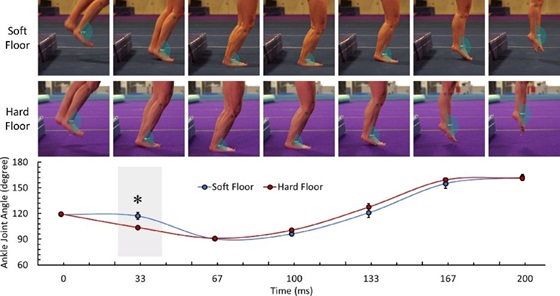
“If gymnasts would train on newer (stiffer) floors, their musculoskeletal systems [could] adapt to these conditions and [would] not suddenly experience greater Achilles tendon strain during competition on stiffer floors,” co-author Emily Muhlenhaupt said.
However, regular access to harder floors for training is not always possible. The researchers are investigating solutions that may help minimize the risk of Achilles tendon ruptures when practicing on softer surfaces.
“Our wish is that our research contributes to the safety of the sport and that administrators or professional organizations adopt performance standards for gymnastics floor equipment that would help to prevent injuries in gymnastics,” co-author Harald M. Stauss, MD, PhD, said.
NOTE TO JOURNALISTS: The American Physiology Summit will be held April 4–7, 2024, in Long Beach, California. To schedule an interview with the researchers, conference organizers or presenters, or to request abstract 1843, “Stiffer gymnastics floors result in more dorsiflexed ankles, potentially increasing the risk for Achilles tendon rupture,” contact APS Media Relations or call 301.634.7314. Find more highlights from the meeting in our Summit Newsroom.
Physiology is a broad area of scientific inquiry that focuses on how molecules, cells, tissues and organs function in health and disease. The American Physiological Society connects a global, multidisciplinary community of more than 10,000 biomedical scientists and educators as part of its mission to advance scientific discovery, understand life and improve health. The Society drives collaboration and spotlights scientific discoveries through its 16 scholarly journals and programming that support researchers and educators in their work.
Related Content
- APS Responds to Proposed Federal Grant Rule Changes
- APS Names Erika Shugart Chief Executive Officer
- APS Selects JPA Health to Lead Strategic Communications Campaign Elevating Physiology’s Vital Role
- Yellow Food Coloring Changes Gut Microbiome in Early Life
- Marathon Running Temporarily Stresses Kidneys, Digestive System
- American Physiological Society Joins National Collaboration on Women’s Health
- Could a New Tool for Diabetes Treatment Be Hiding in Your Spice Cabinet?
 Media Inquiries
Contact the Communications Department to:
- Interview a scientific expert.
- Request a study or journal article.
- Get background and resources on physiology.
Email communications@physiology.org or call 301.634.7314.